Understanding What a Marine Survey Reveals Before You Commit
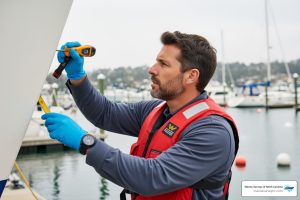
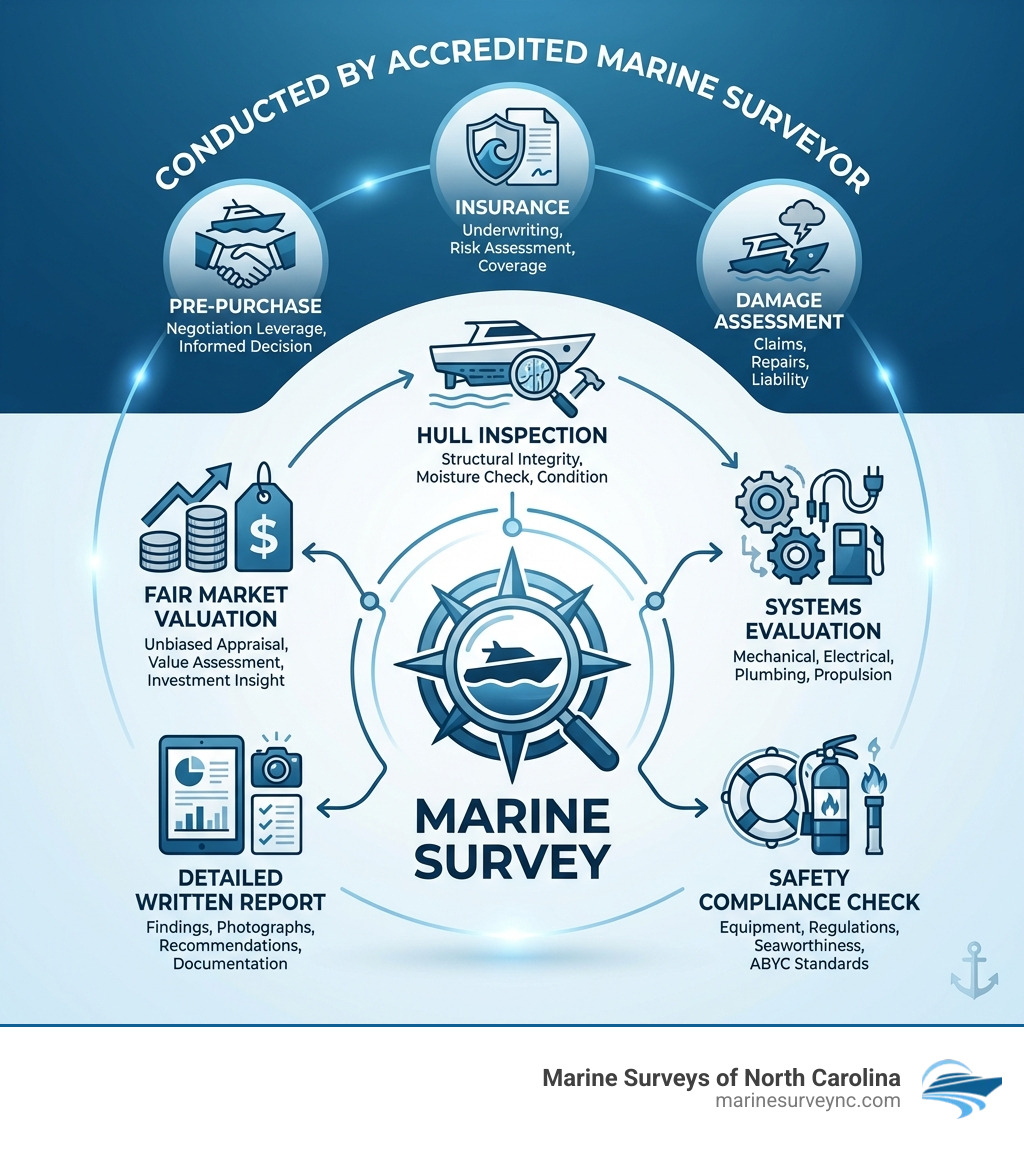
What is a marine survey? It is a comprehensive, professional inspection of a vessel’s structural integrity, mechanical systems, and overall seaworthiness—conducted by a qualified marine surveyor to assess condition, identify defects, and determine fair market value.
Key aspects of a marine survey:
- Purpose: Assess vessel condition, safety, and compliance before purchase, insurance, or financing
- Scope: Hull structure, engines, electrical/fuel systems, safety equipment, and regulatory compliance
- Deliverable: Detailed written report with findings, photographs, recommendations, and valuation
- When Required: Pre-purchase evaluation, insurance underwriting, financing approval, damage claims
- Who Conducts It: Accredited marine surveyors (SAMS, NAMS, ABYC-certified professionals)
- Typical Cost: $20–$25 per foot of vessel length
A marine survey is not a pass/fail test. It is an unbiased, technical evaluation that reveals what lies beneath the cosmetic surface—hidden moisture intrusion, outdated wiring, engine wear, structural concerns, and safety deficiencies that can turn a six-figure purchase into a financial liability.
For boat buyers, it provides negotiation leverage and protection from costly surprises. For insurers and lenders, it verifies that a vessel meets underwriting standards and accurately reflects its stated value. In many cases, a survey is not optional—it is a mandatory prerequisite for coverage or financing, particularly for vessels over 20–30 years old.
The findings in a survey report carry real consequences. They may reveal minor updates needed for compliance, or they may uncover structural damage that disqualifies a vessel from insurance altogether. Either way, the report equips you with the information needed to make an informed, defensible decision.
I’m Andrew Gallant, a SAMS-accredited marine surveyor and principal of Marine Surveys of North Carolina, where I conduct independent vessel inspections across the state’s coastal and inland waterways. My work focuses on delivering clear, thorough assessments that answer what is a marine survey in practical terms—protecting buyers, satisfying insurers, and ensuring vessels meet the standards required for safe, insurable operation.
What is a Marine Survey and Its Primary Purpose?
At its core, what is a marine survey? It is a professional, detailed inspection of a vessel by a qualified expert. The primary purpose of this inspection is to provide an objective, comprehensive assessment of a boat’s condition, structural integrity, and operational capabilities. This evaluation ensures the vessel is safe, seaworthy, and compliant with relevant regulations and industry standards.
Our role as marine surveyors is to act as an impartial third party, offering an unbiased professional opinion on the vessel. This includes a thorough assessment of its current condition and an estimation of its fair market value. Whether you are considering a pleasure craft in Wilmington, a fishing boat in Morehead City, or a yacht on Lake Norman, a marine survey is a critical step in understanding your investment.
A marine survey covers multiple facets:
- Vessel Inspection: This involves a meticulous examination of the boat’s various components, from the hull and deck to the engine and electrical systems.
- Seaworthiness Assessment: We determine if the vessel is structurally sound and equipped to safely operate in its intended marine environment.
- Safety Compliance: We verify that the vessel meets safety standards and regulations, identifying any deficiencies that could pose a risk.
- Risk Management: For buyers, a survey identifies potential issues that could lead to costly repairs or safety hazards. For insurers, it helps assess the risk associated with covering the vessel.
- Unbiased Professional Opinion: Our reports provide a factual, expert perspective, free from the biases of sellers or brokers.
- Condition and Valuation: We document the vessel’s current state and provide an estimated market value, which is crucial for transactions and insurance.
- Regulation Compliance: We ensure the vessel adheres to applicable maritime rules and industry best practices, such as those set by the American Boat & Yacht Council (ABYC).
Understanding these elements is fundamental to appreciating the value a professional marine survey brings to any marine transaction or ownership decision. It’s an investment in knowledge and protection.
The Critical Role of a Survey for Boat Buyers, Insurers, and Lenders
The information gleaned from a marine survey serves as a cornerstone for anyone involved in a boat’s lifecycle, from a prospective buyer to the financial institutions and insurance providers. It is a document that carries significant weight, influencing decisions that protect substantial investments.
For the Prospective Buyer
For individuals looking to purchase a vessel in North Carolina, a marine survey is arguably the most important step before finalizing the transaction. It allows you to know what you are getting. Our experience shows that even seemingly well-maintained boats can harbor significant issues that are not apparent to the untrained eye.
- Financial Protection: A survey helps protect your investment by identifying existing defects or maintenance needs that could lead to unexpected and expensive repairs down the line. It’s about avoiding a “hole in the water that you pour money into.”
- Negotiation Leverage: If a survey uncovers deficiencies, you gain valuable leverage to negotiate a lower purchase price or request that the seller address the issues before closing.
- Understanding Future Maintenance Needs: The report provides a roadmap of the vessel’s condition, outlining not just immediate concerns but also areas that will require attention in the near future. This allows for informed budgeting for maintenance.
- Identifying Hidden Defects: We regularly uncover issues such as hidden moisture intrusion, structural damage, or compromised electrical systems that a casual inspection would miss. These are often among the top hidden issues found in pre-purchase surveys on the NC coast. A professional survey helps you make an intelligent, educated buying decision.
For Insurers and Lenders
Insurance companies and financial institutions also rely heavily on marine surveys. For them, a survey is not just a recommendation; it is often a mandatory requirement to mitigate their financial risk.
- Mandatory Requirement: Many insurance companies, especially for older vessels, will not provide a quote or insure a boat without a satisfactory marine survey conducted by a qualified professional. For boats over 30 years old, regardless of size, a marine survey becomes almost mandatory.
- Risk Assessment: Insurers use the survey report to accurately assess the risk associated with providing coverage. A detailed report helps them understand the vessel’s condition, safety features, and potential liabilities.
- Verifying Vessel Value: Lenders require an appraisal survey to confirm the boat’s fair market value, ensuring their loan is adequately secured.
- Insurance Eligibility: The findings dictate whether a vessel is eligible for insurance and, if so, under what terms and premiums. Insurance companies typically require a marine survey for boats based on their age, size, and type.
- Financing Prerequisite: Many lenders will not finance a used boat purchase without a recent and satisfactory marine survey.
- Survey Validity Timelines: Insurance companies generally adhere to strict timelines. A survey must typically be completed within the last two years to qualify for a new policy. After securing coverage, most insurers require updated surveys every five years to continue your coverage.
By providing a clear and objective evaluation, the marine survey acts as a cornerstone for all parties, ensuring transparency, protecting investments, and promoting safer boating practices across North Carolina’s waterways.
Types of Marine Surveys and What They Cover
The term “marine survey” is broad, encompassing several specialized inspections custom to different needs and circumstances. Each type serves a distinct purpose, offering specific insights into a vessel’s condition, value, or compliance.
| Survey Type | Primary Purpose | When It’s Used |
|---|---|---|
| Pre-Purchase Survey | The most comprehensive inspection, evaluating the entire vessel’s structural integrity, systems, and overall condition to determine its suitability for purchase and fair market value. It protects the buyer’s interests by uncovering defects and providing negotiation leverage. | Essential before buying any used boat. It’s often a prerequisite for obtaining financing and insurance. |
| Insurance Survey | Focuses on key risk areas to assess a vessel’s insurability and compliance with underwriter requirements. It helps insurers determine risk and premium. | Required by insurance companies for older boats (e.g., over 20-30 years old), larger vessels, or when renewing an existing policy. Often less detailed than a pre-purchase survey, focusing on specified items. |
| Damage Survey | Investigates the nature, cause, and extent of damage to a vessel following an incident (e.g., collision, grounding, storm). It also estimates repair costs and recommends repair procedures. | Conducted after an accident or incident for insurance claims, legal disputes, or to plan repairs. |
| Appraisal Survey | Determines the fair market value of a vessel, often without a detailed inspection of all systems. | Used for financing, estate settlements, divorce proceedings, donations, or legal disputes where an accurate valuation is needed. |
| New Yacht Survey | A specialized survey for large, expensive, or custom-built yachts, sometimes conducted in stages during construction. | Performed for custom-built yachts or very large, expensive vessels, often involving multiple visits to the manufacturer during the construction process. Reputable production boatbuilders often do not require these due to their adherence to American Boat & Yacht Council (ABYC) standards and third-party inspections. |
| Walk-Through Inspection | A verbal-only assessment, often with photos, to give a prospective buyer a quick overview of a vessel’s general condition and suitability. | Useful for out-of-town buyers to gauge initial suitability of a boat in an area like Beaufort or New Bern before incurring travel costs for a full inspection. It helps decide if a full pre-purchase survey is warranted. |
A Breakdown of Common Survey Types
Understanding the specific needs of our clients in North Carolina, we offer various types of marine surveys:
- Pre-Purchase Survey: This is the most comprehensive inspection we provide. Our Pre-Purchase Marine Survey goes beyond the surface, examining nearly every aspect of the vessel to give you a complete picture before you commit. This includes everything from structural integrity to operational systems and overall condition, helping you make an informed decision and gain negotiation leverage. This is often referred to as a Condition and Valuation Survey for Boat Purchase.
- Insurance Survey: Required by most insurance companies for coverage, especially for older vessels. Our Insurance Survey focuses on key risk areas and overall condition to ensure the boat meets underwriting standards.
- Damage Surveys: In the unfortunate event of an incident, our Damage Surveys assess the extent, cause, and nature of the damage. This report is crucial for insurance claims and repair planning. We can help you understand how to use a damage survey to identify necessary repairs and save money.
- Appraisal Survey: This survey establishes the fair market value of a vessel. It is often required for financing, estate settlements, or legal purposes.
- New Yacht Survey: While less common for production boats, new yacht surveys are sometimes performed for large, custom-built vessels. These surveys may involve multiple visits during the construction process to ensure quality and adherence to specifications.
What a comprehensive marine survey covers
When we conduct a marine survey, our inspection is thorough and systematic, covering all critical areas of the vessel. We leave no stone unturned, literally, in assessing the boat’s condition.
- Hull and Structure: This is paramount. We carefully examine the hull for signs of damage, delamination, osmotic blisters, or repairs. This includes inspecting the keel, stringers, bulkheads, and other structural components for integrity. For wooden boats, this might involve checking below-the-waterline fasteners.
- Deck and Superstructure: We inspect the deck for soft spots, cracks, proper drainage, and the condition of non-skid surfaces. The superstructure is examined for integrity, watertightness, and proper fit and finish.
- Engine Systems Review: This is a crucial component for any power vessel. We inspect the main propulsion engine(s) and auxiliary generators, checking for leaks, corrosion, proper installation, and overall condition. While not a mechanical inspection, we identify any apparent issues and recommend further mechanical evaluation if warranted.
- Electrical Systems: We evaluate the vessel’s DC and AC electrical systems for proper installation, wiring, battery condition, and compliance with safety standards, including adherence to American Boat & Yacht Council (ABYC) standards.
- Fuel Systems: A critical safety component, we inspect the fuel tanks, lines, filters, and ventilation for leaks, corrosion, proper installation, and compliance with safety regulations.
- Plumbing and Sanitation: We examine fresh water, waste, and bilge pump systems for leaks, proper operation, and sanitation compliance.
- Safety Equipment: We check for the presence and condition of required safety gear, such as life jackets, fire extinguishers, flares, and navigation lights.
- Compliance with American Boat & Yacht Council (ABYC) standards: ABYC standards are the authoritative reference for evaluating design, construction, maintenance, and product performance in the marine industry. Our surveys assess the vessel’s adherence to these critical safety and operational guidelines.
This detailed approach ensures that our clients receive a comprehensive and accurate assessment, empowering them to make confident decisions about their vessel in North Carolina.
The Marine Survey Process: From Hiring a Surveyor to Understanding the Report
Starting on a marine survey journey can seem daunting, but understanding the process clarifies expectations and ensures a smooth experience. Our goal is to make this essential step as transparent and straightforward as possible for our clients in North Carolina.
How to Choose a Qualified Marine Surveyor
Choosing the right marine surveyor is paramount. The marine surveying industry is largely unregulated, meaning it lacks national or international licensing. This makes professional credentials and affiliations critically important.
- Impartiality: Always ensure your chosen surveyor is independent and unbiased. They work solely for you, the client, and report to no one else, protecting your interests. Yacht brokers, for ethical reasons, cannot recommend specific surveyors.
- Professional Credentials: Look for surveyors who are credentialed members of recognized professional associations. These organizations uphold codes of ethics and require continuing education.
- SAMS or NAMS Membership: We are a SAMS SA certified firm. The Society of Accredited Marine Surveyors (SAMS) and The National Association of Marine Surveyors (NAMS) are two leading professional bodies that provide rigorous accreditation and maintain rosters of qualified surveyors. Membership signifies a commitment to high standards and ongoing professional development.
- Errors & Omissions Insurance: A reputable surveyor should carry Errors & Omissions (E&O) insurance, also known as professional liability insurance, to protect both themselves and their clients.
- Local Expertise: A surveyor familiar with the local North Carolina boating environment, including specific marinas in Wilmington, Beaufort, or Morehead City, can offer valuable insights into regional issues, common local problems, and resources. They often have experience with the types of vessels and conditions prevalent in our waters.
When contacting potential surveyors, ask about their experience with your specific type of vessel, their training, what their report includes, and their fees.
What to Expect During the Survey: Cost, Duration, and Your Role
Once you’ve selected your surveyor, preparing for the survey is the next step. Our aim is to make the process efficient and effective.
- Per-Foot Pricing: The cost of a marine survey in North Carolina can vary, but as a general rule of thumb, plan on spending around $20 to $25 per foot of boat length. Many surveyors have a minimum charge that may apply to smaller vessels. For example, a 30-foot boat might cost between $600 and $750.
- Hourly Rates: Some surveyors may charge an hourly rate, typically ranging from $75 to $150 per hour, depending on their experience and the complexity of the inspection.
- Haul-Out Requirement: For a comprehensive pre-purchase or insurance survey, the vessel typically needs to be hauled out of the water for a thorough inspection of the hull, running gear, and underwater appendages. This is an additional cost, usually paid directly to the marina.
- Survey Duration: The time required for a marine survey varies significantly based on the vessel’s size, type, age, and complexity. A smaller boat might take a few hours, while a larger yacht could take a full day or even two.
- Buyer Presence Recommended: While not mandatory, we often recommend that the buyer be present during at least part of the survey, especially during the haul-out and sea trial. This provides a valuable opportunity to learn about the vessel firsthand, ask questions, and gain a deeper understanding of its condition.
- Your Role: To save time and additional expense, the vessel should be clean, shipshape, and accessible. Ensure all lockers and cabin areas are cleared of miscellaneous gear. Have all vessel papers ready. If any dismantling (e.g., of interior panels for access) is requested by the surveyor, it is the client’s responsibility to arrange for qualified personnel to perform this, not the surveyor’s.
For more detailed information, please see our FAQ for more details.
Understanding the marine survey report and its implications
The culmination of the marine survey process is the comprehensive written report. This document is your most valuable asset, providing a clear, methodical, and precise overview of the vessel’s condition.
- Detailed Findings: The report will carefully document our observations, including the vessel’s specifications, construction, and the condition of all inspected systems. We strive for clarity, conciseness, and accuracy in all our reports.
- Photographs: High-quality photographs are included to visually support the written findings, illustrating both positive aspects and any identified deficiencies.
- Actionable Recommendations: Beyond simply listing issues, our reports provide clear, actionable recommendations for repairs, maintenance, or upgrades. These recommendations are prioritized based on safety, structural integrity, and regulatory compliance.
- Fair Market Valuation: The report will include our professional assessment of the vessel’s fair market value, which is crucial for insurance, financing, and purchase decisions.
- Impact on Insurance and Financing: The findings and recommendations directly influence the vessel’s insurability and eligibility for financing. Addressing critical recommendations is often a prerequisite for obtaining or maintaining coverage and loans.
- A Tool for Decision-Making: The marine survey report is a powerful tool. It equips you with the objective information needed to make an informed decision: proceed with the purchase (perhaps with a negotiated price), request the seller to make repairs, or walk away from a potentially problematic investment.
We ensure that after reviewing our report, you have a clear understanding of the vessel’s overall condition and any necessary actions to take.
Frequently Asked Questions about Marine Surveys
We often receive questions from serious buyers and boat owners about the practicalities of marine surveys. Here are some of the most common inquiries, addressed directly to provide clarity and confidence.
How much does a marine survey typically cost?
The cost of a marine survey varies depending on several factors, including the vessel’s size, type, age, and the specific scope of the survey requested. However, as a general rule of thumb, plan on spending around $20 to $25 per foot of boat length for a comprehensive pre-purchase survey. For smaller vessels or specific insurance surveys, some surveyors may offer flat fees, often in the range of $400 to $800. That additional costs may apply for travel, haul-out services at the marina (which is typically necessary for a thorough hull inspection), and any specialized testing. While this represents an upfront investment, it is a small fraction of the vessel’s value and can save you thousands in unexpected repairs or liabilities down the line.
How long is a marine survey valid for insurance purposes?
Insurance companies have specific requirements regarding the recency of a marine survey. For a new insurance policy, most insurers in North Carolina will require a survey that has been completed within the last two years. This ensures that the assessment of the vessel’s condition is current and accurately reflects its risk profile. After securing coverage, most insurers require updated surveys periodically, typically every five years, to continue your coverage. It’s important to check with your specific insurance provider for their exact requirements, as these can vary based on the vessel’s age, size, and type. For instance, boats over 30 years old often face stricter requirements.
Does a “pass” on a survey guarantee the boat is perfect?
A marine survey is not a “pass” or “fail” test, nor does it serve as a warranty. A marine survey is a professional assessment of the vessel’s condition at a specific point in time. Our report provides an objective, detailed account of what we observe, identifying existing issues, potential concerns, and areas that require attention. It equips you with facts and expert recommendations, but it does not guarantee that the boat is “perfect” or that no future issues will arise. The purpose is to inform your decision-making, allowing you to proceed with confidence, negotiate repairs, or reconsider your purchase based on a clear understanding of the vessel’s true state. The responsibility for addressing the recommendations and deciding whether to proceed with the transaction ultimately rests with you.
Protecting Your Investment with a Professional Survey
A marine survey is an essential investment in safety, financial security, and peace of mind. It provides an objective, in-depth understanding of a vessel’s condition, moving you beyond the surface to the critical systems that ensure seaworthiness. Not every vessel will meet the stringent standards required for insurance or safe operation, and a thorough survey provides the objective clarity needed to make a sound decision. As SAMS SA certified professionals, Marine Surveys of North Carolina is committed to delivering this clarity.