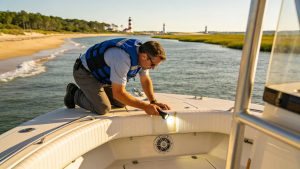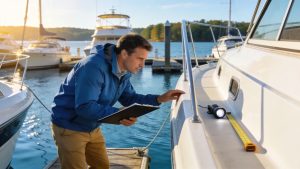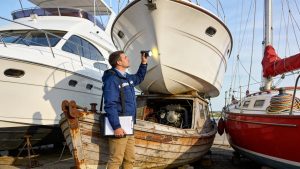
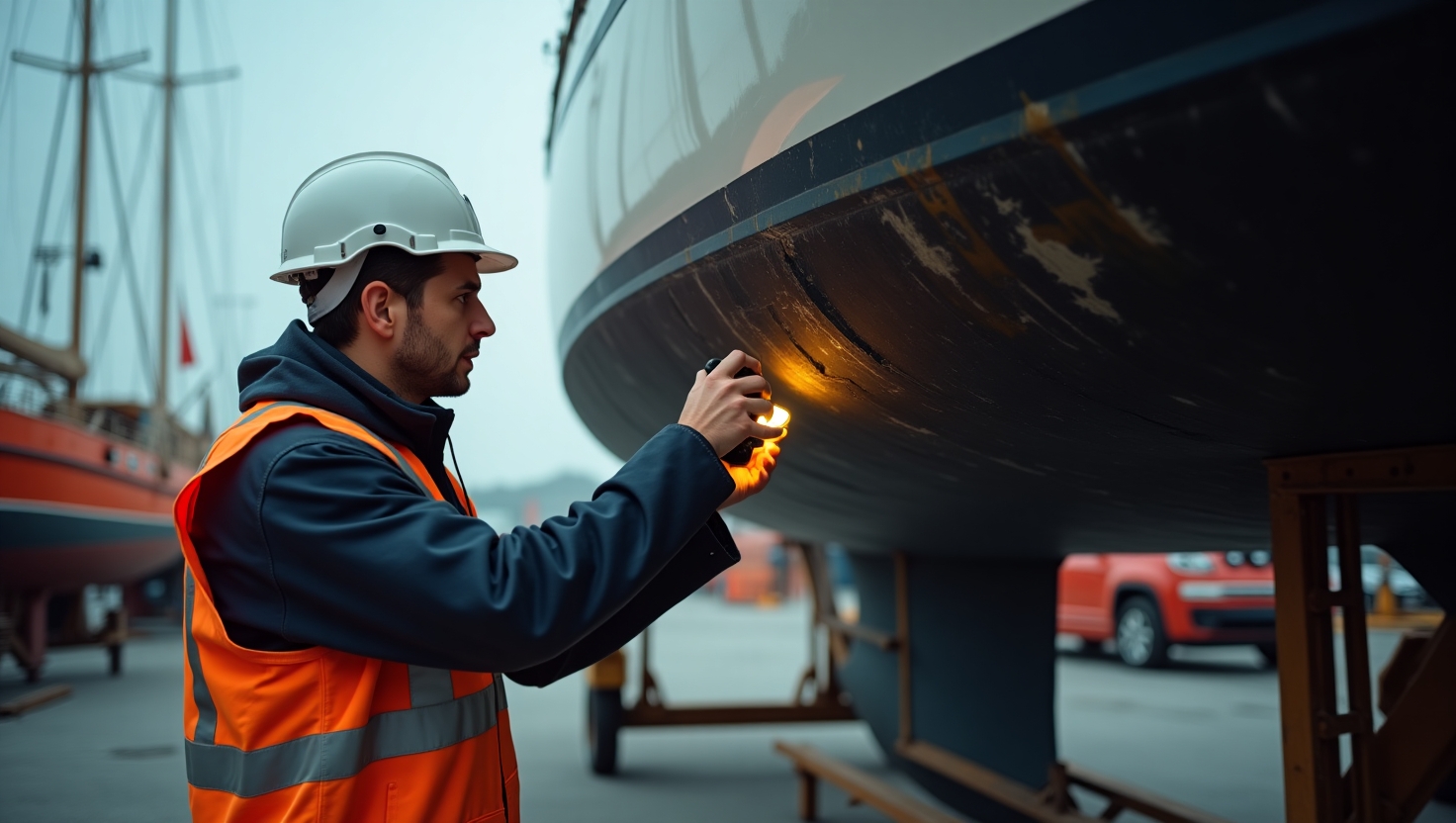
A practical guide for North Carolina boat owners who have received an insurance survey requirement — and want to understand what comes next.
Important Before You Read Further
An insurance survey is performed for vessel owners. If you already own the boat and your insurer is asking for a current survey, you are in the right place. If you are still purchasing a vessel and ownership has not yet transferred, what you need is a pre-purchase survey — a different scope and a different engagement.
Why Your Insurer Is Asking
So it arrives — in your inbox or mailbox, looking like any other piece of routine correspondence. A letter from Geico Marine, Progressive, State Farm, BoatUS, or one of the other marine insurance providers asking that you arrange a survey before your policy can be renewed. For many boat owners, the first reaction is mild frustration. What follows is a guide to understanding exactly why that letter was sent, what to expect when the surveyor steps aboard, and — more importantly — how to use the process to your genuine advantage.
A boat is not like a car, and it is certainly not like a house — at least not in the way insurance companies think about risk. When you insure an automobile, underwriters have access to hundreds of thousands of comparable vehicles: production records, recall histories, standardized valuations, and years of actuarial data. Pricing a policy on a 2018 Toyota Camry is, relatively speaking, a solved problem.
A vessel is an entirely different matter. Consider two 1985 Hatteras sportfishers sitting in the same marina. One has been meticulously maintained, comprehensively restored, and is worth several hundred thousand dollars. The other has been neglected — soft decks, deferred engine work, corroded through-hulls — and may realistically be worth twenty thousand. I have surveyed both, sometimes in the same week. Without an independent, professional assessment, there is simply no reliable way for an underwriter to know which one they are insuring, or whether the agreed value on the policy bears any relationship to reality.
The Core Reason
If your home insurer discovered that two identical houses on the same street could differ in value by a factor of ten depending on what was hidden behind the walls and beneath the floors, they would require periodic professional inspections too. Marine insurance surveys exist for precisely the same reason.
Common Triggers for an Insurance Survey Requirement
- Vessel age — Age thresholds vary by carrier, but older boats are more likely to have legacy electrical work, aging fuel lines, corroded seacocks, or outdated safety gear.
- New to the insurer — First-time underwriting on the vessel often triggers a survey requirement regardless of age.
- Policy renewal with new underwriting rules — Carriers periodically tighten requirements after loss cycles, storm seasons, or changes in reinsurance.
- High hull value or increased limits — The larger the insured value, the more documentation underwriters require.
- Major refit or modification — Repower, generator addition, fuel system changes, electrical upgrades, or extended periods out of service.
- Change in navigation area — Moving from an inland lake to the coast, or to higher-wind exposure areas, changes the risk profile.
Vessel Valuation: How a Number Gets Assigned
One of the most important functions of the survey is establishing an accurate valuation for the vessel. As a surveyor, I am required to assign a defensible market value — and arriving at that number is not guesswork. The process involves:
- Researching current comparable listings to understand what similar vessels are actively selling for
- Reviewing sold boat data to see what buyers have actually paid
- Consulting industry valuation tools such as BUC ValuePro, which aggregates market data specific to the marine industry
Why This Number Matters to You
The valuation directly informs the agreed value on your policy. Too low and you are underinsured in a total loss. Too high and you are paying premiums on value that is not there. Getting it right protects both parties.
The Surveyor’s Obligation: Telling the Truth
Here is something worth understanding clearly, because it occasionally creates friction: by professional ethics rules and the standards of certifying organizations, a marine surveyor is required to accurately represent the condition of the vessel on the day of the survey. Period.
You are the one who hired me and paid my fee. But the survey report is ultimately a document submitted to an underwriter, and I cannot misrepresent the vessel’s condition to that underwriter without assuming serious personal and professional liability — and without risking my certification. The surveyor’s ethical obligation to accuracy is not a bureaucratic formality. It is the foundation upon which the entire professional relationship between surveyors and insurers rests.
What This Means Practically
If there is a deferred maintenance item, I am going to note it. If a system does not meet applicable standards, that will be in the report. The best approach is not to hope the surveyor will look the other way — it is to address known issues before the survey date.
The Survey Has Evolved — Significantly
If you had a boat surveyed ten or fifteen years ago, you may remember the process as relatively brief. A surveyor would step aboard, walk the vessel, check the obvious items, and move on. Those days are largely gone. Underwriters have become substantially more engaged in the survey process. They attend industry meetings, they revise their requirements, and they expect surveyors to evaluate vessels against applicable standards. A modern insurance survey is a thorough, standards-based inspection — not a cursory walkthrough.
The three bodies whose standards govern what a surveyor evaluates:
| Standards Body | What It Governs |
|---|---|
| ABYC (American Boat and Yacht Council) | Electrical systems, fuel systems, safety equipment, plumbing, ventilation — the primary technical standard for recreational vessels |
| NFPA 302 (National Fire Protection Association) | Fire protection, suppression systems, and fire safety practices aboard pleasure and commercial motor craft |
| 33 CFR (U.S. Coast Guard Regulations) | Federal carriage requirements — navigation lights, life jackets, fire extinguishers, distress signals |
Note on Haul-Out and Sea Trial
Unless specifically requested by your insurance company, a short haul and a sea trial are generally not required for an insurance renewal survey. If your insurer requests either, that will be communicated in advance.
Do Not Wait Until the Last Moment
When that letter arrives, your insurance provider will include a deadline for submitting the completed survey report. It is easy to set the letter aside and deal with it later — but that is a mistake I see play out regularly. I have worked with owners who scheduled their survey the week before the report was due, only to find themselves with little to no time to correct the deficiencies their insurer required to be addressed before the policy could be renewed. In some cases that means a scramble to find parts, schedule contractors, or source equipment on short notice. In others it means a lapse in coverage.
Action Item
The moment you receive the letter, schedule the survey. Give yourself enough runway that if something comes up — and something often does — you have time to address it, have it verified if necessary, and still meet your deadline comfortably. A few weeks of lead time can make the difference between a straightforward renewal and a stressful one.
Pre-Survey Preparation: The Most Common Findings
Rather than viewing the survey as something happening to you, consider it a professional inspection working for you. Maintenance issues have a way of hiding in the places owners rarely look — shaft packing glands, rudder packing glands, exhaust components tucked deep in a lazarette, through-hull fittings behind built-in furniture. A thorough survey brings all of it into the light.
The items below represent the most common deficiencies found during insurance surveys. Addressing these before the surveyor arrives saves time, avoids surprises, and puts you in the best possible position going into your renewal.
Six Items to Check Before the Surveyor Arrives
- Fire extinguishers — Portable disposable units have a 12-year service life from the manufacture date. Check that they are properly mounted, readily accessible, and that gauges and seals are intact. Verify you have the minimum required count for your vessel size.
- Flares and visual distress signals — Pyrotechnic signals expire after a few years and do not satisfy Coast Guard carriage requirements once expired. If the kit has been sitting unused for multiple seasons, replace it. Consider an electronic visual distress signal paired with a day signal flag as a long-term alternative that does not require periodic replacement.
- Sound signaling device — Every vessel is required to carry a whistle, air horn, or compressed air canister. A fixed electric horn at the helm does not satisfy the requirement for an independent device.
- Required placards — Federal requirements scale with vessel length. See the table below for what applies to your boat.
- Personal flotation devices — USCG-approved, one per person aboard, plus at least one Type IV throwable device that is immediately accessible. Inspect for deteriorating fabric, broken buckles, and expired CO2 cartridges on inflatable models. A PFD stored at the bottom of a locker under gear does not satisfy the readily accessible requirement.
- Navigation lights — Walk the vessel at dusk before your survey date and verify that bow, stern, masthead (if applicable), and anchor lights all illuminate. Replace burned bulbs, address corroded sockets.
Required Placards by Vessel Length
| Vessel Length | Required Placards and Documentation |
|---|---|
| All motor vessels | No Discharge of Oil placard |
| 26 feet and over | No Discharge of Oil placard + Trash Disposal placard |
| 39 ft 4 in and over | All above + Written Waste Management Plan + Copy of USCG Navigation Rules (print or downloadable app) |
Safety Systems: What the Standards Require
Carbon Monoxide Detection
Carbon monoxide is a genuine and recurring cause of boating fatalities — invisible, odorless, and fast-acting. CO detection is required in any habitable space aboard.
ABYC H-24.5.1
A carbon monoxide detector shall be installed to monitor the atmosphere in habitable spaces.
ABYC H-24.4.3 — Habitable Space Defined
Space surrounded by permanent structure in which there is provision for any of the following activities: sleeping, cooking, eating, washing, toilet, navigation, or steering.
In practical terms: your cabin, pilothouse, and any enclosed areas where people sleep or spend extended time must have a functioning CO detector. If your vessel lacks one — or if the existing detector is outdated — this is a priority item to address before the survey.
Smoke Detection
NFPA 302, Section 13.4.2
A smoke alarm or smoke detector shall be installed in every sleeping area that is not open to a weather deck.
Bilge High-Water Alarm
On vessels with enclosed accommodation compartments, a functioning bilge alarm is a required safety system. Rising bilge water in an enclosed space can reach critical systems long before it becomes visible.
ABYC H-22.7.3
On boats with an enclosed accommodation compartment, an audible alarm shall be installed indicating that bilge water is approaching the maximum bilge water level.
Common Installation Error
Check that your bilge alarm is functional and positioned correctly — not just that one exists. A sensor mounted too high provides little useful advance warning.
LP / Propane Systems
If your vessel has an LP system for cooking or other appliances, the following are required:
- Tank secured in a dedicated vented locker
- Regulator installed at the tank
- Pressure gauge present
- System must hold pressure for a minimum of three minutes with all appliance valves closed
ABYC A-1
After pressurization, the system shall maintain pressure with all appliance valves closed for not less than three minutes, without a drop in pressure.
Fixed Fire Suppression Systems
Any vessel with an enclosed engine space is required to have a means of discharging extinguishing agent directly into that space without opening the primary access hatch.
NFPA 302, Chapter 12, Section 12.1.1.1
All boats with an enclosed machinery space shall have provision for discharging extinguishing agent directly into the space immediately surrounding the engine without opening the primary access — either via a fixed suppression system, or a portable clean agent or CO2 extinguisher used through a dedicated discharge port.
There are two compliant options. The fixed automatic suppression system is the gold standard — it activates when heat reaches a threshold and discharges agent automatically, even if no one is present. The portable clean agent extinguisher through a dedicated discharge port is the second option, but the extinguisher must have a hose so agent can be directed into the engine space without opening the hatch and feeding the fire with oxygen.
| Factor | Clean Agent System | Halon System |
|---|---|---|
| Effectiveness | Highly effective | Highly effective |
| Environmental status | Acceptable | Ozone-depleting; EPA phase-out in progress |
| Recharge availability | Readily available | Increasingly difficult and expensive |
| Required service interval | Annual | Semi-Annual |
| Recommended path forward | Yes | Evaluate transition now |
If Your Vessel Has a Halon System
Now is a good time to evaluate transitioning to a clean agent alternative — before that decision is made for you by tightening EPA regulations and diminishing recharge availability.
North Carolina Context: Why Waterways and Usage Matter
North Carolina is not one uniform risk profile. Insurers ask not only what the boat is, but where it is kept and how it is used. Those answers change the underwriting picture significantly.
| Location / Waterway | Risk Considerations |
|---|---|
| Lake Norman | Freshwater environment; different corrosion exposure and haul-out patterns than coastal vessels |
| Wilmington / Cape Fear River | Coastal and ICW use; grounding realities and saltwater corrosion more relevant |
| Morehead City / Beaufort Inlet | Higher offshore-use likelihood; increased storm and inlet-passage exposure |
| New Bern / Neuse River / Pamlico Sound | Shoaling risk, significant fetch, and seasonal weather patterns affect risk assessment |
The Value of the Process
An insurance survey is ultimately about more than satisfying a renewal requirement. It is a professional, standards-based review of the vessel you and your family depend on — conducted in the spaces and systems that rarely get examined between haul-outs and routine maintenance.
A good survey finds the shaft packing gland that has been weeping slowly for a season. It identifies the fire suppression system that has been out of service for years. It catches the CO detector with a dead battery in the forward cabin. These are not abstract regulatory failures — they are the conditions that lead to real emergencies on the water.
The Right Perspective
When the letter arrives, take it as an invitation: to prepare, to address deferred maintenance, and to put a professional set of eyes on your vessel before the next season begins. The survey is not working against you. Done right, it is one of the best safety investments you can make.
Andrew Gallant — Marine Surveys of North Carolina
The Society of professional marine surveyors (SAMS) — Surveyor Associate
ABYC Certified: Electrical, Systems, Standards
919.820.9257 | marinesurveync.com