Why Professional Boat Inspection Services Are Essential for Serious Buyers
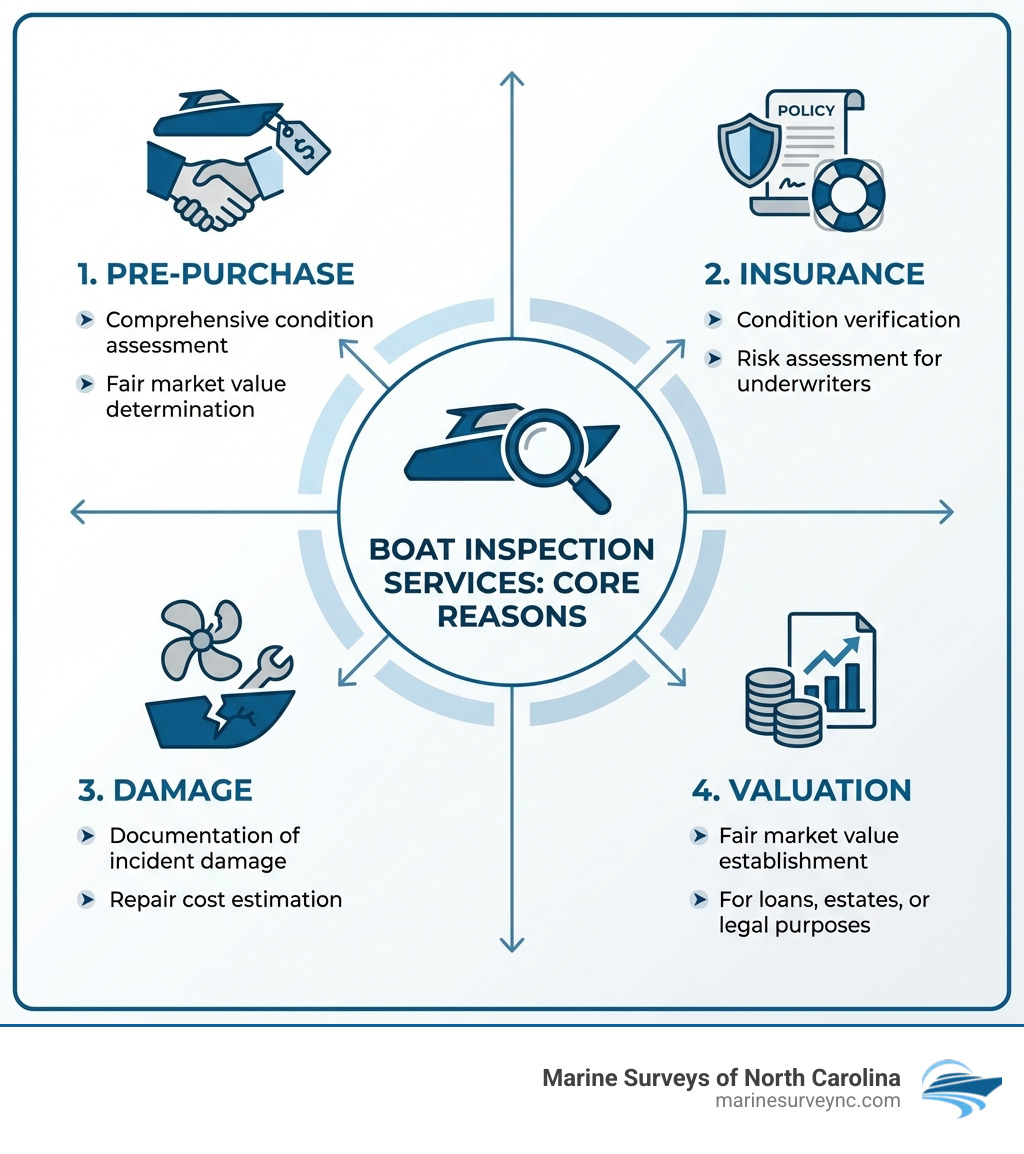
Boat inspection services provide objective, detailed assessments of a vessel’s condition and value before a purchase becomes permanent. Whether you’re buying a used yacht, renewing insurance, or documenting damage after an incident, a professional marine survey is your primary tool for identifying costly issues and protecting a significant financial investment.
Quick Answer: What You Need to Know About Boat Inspection Services
| Service Type | Primary Purpose | When You Need It |
|---|---|---|
| Pre-Purchase Survey | Assess condition, identify defects, determine fair market value | Before buying any used vessel over 16 feet |
| Insurance Survey | Verify condition and value for underwriters | Required for boats over 10 years old, or policy renewal |
| Damage Survey | Document extent of damage and repair costs | After an incident or for insurance claims |
| Valuation/Appraisal | Establish fair market value | For loans, estate settlements, or tax documentation |
A marine survey is often the last opportunity to identify serious structural, mechanical, or electrical problems before you commit to a purchase. According to industry data, Condition & Valuation surveys are commonly performed on most used boats 16 feet in length or larger and are usually required to obtain insurance, especially on boats older than 10 years. A comprehensive survey can save a prospective buyer thousands of dollars by revealing hidden defects and helping establish the vessel’s true fair market value.
The typical survey examines all accessible areas of the vessel, including hull integrity, deck condition, propulsion and electrical systems, plumbing, steering, running gear, and safety equipment. Modern surveys also incorporate advanced technology like thermal imaging to detect moisture intrusion, delamination, and electrical hot spots that are invisible to the naked eye.
Not every vessel will meet insurance or safety standards, and not every buyer is prepared for what a thorough survey may uncover. A professional marine surveyor’s role is to provide an unbiased, detailed report that empowers you to make an informed decision—whether that means proceeding with the purchase, negotiating a lower price based on necessary repairs, or walking away from a vessel with undisclosed problems.
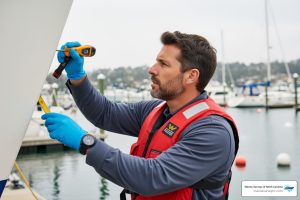
I’m Andrew Gallant, a SAMS® accredited marine surveyor and ABYC certified Master Technician with Marine Surveys of North Carolina, where I conduct independent pre-purchase surveys, insurance inspections, and damage assessments across the state’s coastal and inland waterways. My approach to boat inspection services emphasizes thorough, standards-compliant reporting that protects vessel investments and provides clients with actionable, data-driven insights they can trust.
Understanding the Scope: Types of Marine Surveys and Inspections
A marine survey is not a one-size-fits-all service; the type of inspection you need depends entirely on your objective, whether it’s for a purchase, insurance renewal, or damage assessment. Understanding these distinctions is crucial for obtaining the right information to protect your interests. We offer various boat inspection services custom to specific needs, each designed to provide clarity and mitigate risk.
The Pre-Purchase Survey: Your Most Critical Due Diligence Step
When considering a vessel acquisition, a pre-purchase survey stands as your most critical due diligence step. This comprehensive inspection is designed to ascertain a vessel’s condition and operational capability. It provides a deep dive into the vessel’s structural integrity and systems, identifying potential issues that could lead to costly repairs or compromise safety. Our pre-purchase surveys often uncover hidden issues that might not be apparent during a casual viewing, such as those detailed in our guide on Top 7 Hidden Issues Found in Pre-Purchase Surveys on the NC Coast. The report from this survey can also be leveraged for insurance and financing purposes, making it an indispensable component of the buying process. For a detailed understanding of what this entails, refer to our Pre-Purchase Boat Survey North Carolina page. This type of survey is essential for assessing the fair market value of the vessel, ensuring you understand exactly what you are purchasing.
Insurance, Valuation, and Damage Surveys
Beyond the initial purchase, various situations necessitate specialized boat inspection services. An insurance survey, often referred to as a Condition & Valuation Survey, is frequently required by underwriters. Its purpose is to determine if the vessel poses an acceptable insurance risk, with a strong emphasis on safety, integrity, and compliance with relevant standards. This is particularly common for boats older than 10 years or when initiating a new policy. You can learn more about this on our Insurance Survey page.
A valuation survey, or appraisal survey, is performed to establish a fair market value for a vessel. This is crucial for obtaining a loan, settling an estate, or for legal documentation, such as for tax purposes related to donations. It provides an objective assessment of the vessel’s worth based on its condition and market comparables.
In the unfortunate event of an incident, a damage survey becomes necessary. Commissioned by an insurance company as part of a claim investigation, its role is to establish the extent of damage and provide an estimate of repair costs. A thorough damage survey ensures that all affected areas are identified and properly addressed, which can save money and prevent future complications. Our guide, How to Use a Damage Survey to Identify Necessary Repairs and Save Money, offers further insights into this critical service. Our Damage Surveys page also provides additional information.
Preliminary “Walk-Through” vs. Full Marine Survey
For out-of-area buyers, or those looking to gain an initial understanding of a vessel’s general condition without committing to a full survey, a preliminary “walk-through” inspection can be a cost-effective solution. This service provides a high-level overview, offering verbal feedback and photos to help a remote buyer decide if a vessel is worth pursuing further. It is not a substitute for a full marine survey, but rather a preliminary assessment designed to save time and travel expenses by filtering out unsuitable vessels early in the process.
A walk-through inspection differs from a full marine survey significantly. While a full survey involves an in-depth, systematic examination of all accessible components and systems, a walk-through is a more superficial check. It focuses on readily observable areas and major systems to identify any immediate red flags. The distinction between these two boat inspection services is crucial for making the right choice, as detailed in our article Preliminary vs. Full Marine Survey: Making the Right Choice.
The Anatomy of a Professional Boat Inspection
A professional survey is a methodical, hands-on process that examines the vessel both in and out of the water. It combines traditional techniques with modern technology to create a comprehensive picture of the boat’s condition. Our approach ensures that every accessible aspect of the vessel is scrutinized, providing a complete and accurate assessment.
Key Areas Inspected from Bow to Stern
A typical marine survey involves a meticulous examination of the vessel’s major and minor systems. This includes, but is not limited to, the hull, decks, electrical systems, propulsion, running gear, steering system, helm station and electronics, plumbing systems, HVAC, rigging, firefighting equipment, fuel systems, and ventilation. A thorough inspection leaves no accessible system unchecked, ensuring a complete overview of the vessel’s health. For instance, we carefully inspect the hull for signs of damage, delamination, or previous repairs, both visually and often with specialized tools. Decks are checked for soft spots, indicating core saturation, and all through-hull fittings are examined for integrity.
Propulsion systems, including engines and transmissions, are evaluated for general condition, leaks, and signs of improper maintenance. Electrical systems are scrutinized for proper wiring, corrosion, and safety compliance, particularly with ABYC standards. Running gear, such as propellers, shafts, and rudders, is inspected for damage or misalignment. Safety equipment is inventoried and checked for currency and proper functioning. Our page, What Does a Pre-Purchase Boat Survey in North Carolina Include?, offers a detailed breakdown of these areas. Additionally, an Engine Systems Review can be performed for a deeper dive into the vessel’s power plant.
The Role of Technology in Modern Surveys
Modern boat inspection services leverage advanced technology to uncover issues that are not visible to the naked eye. Thermal imaging, for instance, is a powerful non-destructive testing (NDT) method we employ. It allows us to evaluate fiberglass and composite materials for issues like debonds, voids, delamination, and hidden liquid intrusion by detecting subtle temperature differences. This technology is also invaluable for troubleshooting electrical and mechanical systems, as it can pinpoint hot spots indicative of overloaded circuits, loose connections, or failing components.
Moisture meters are another essential tool, providing quantitative data on moisture content in fiberglass laminates and wooden structures, which can indicate leaks or structural compromise. These technologies provide objective evidence of potential problems, allowing for a more precise assessment of the vessel’s condition. Our adherence to standards like those from the American Boat & Yacht Council – ABYC ensures that these technologies are used effectively and professionally.
Deciphering the Marine Survey Report
The culmination of our boat inspection services is a detailed marine survey report. This document is far more than a simple checklist; it is a comprehensive, legal document that outlines the vessel’s condition, its fair market value, and its replacement value. The report includes detailed findings, often accompanied by photographic evidence, and a prioritized list of necessary repairs or safety upgrades.
Our reports clearly distinguish between recommendations for maintenance or minor repairs and critical deficiencies that require immediate attention. We provide clear, direct explanations of our findings, ensuring that you, the buyer or owner, understand the implications of each item. This report serves as a critical tool for negotiation, insurance purposes, and future maintenance planning. It provides the objective information needed to make informed decisions and protect your investment in North Carolina waters.
Choosing and Engaging Professional Boat Inspection Services
Selecting the right surveyor is as important as the survey itself. A qualified professional adheres to strict standards and provides an unbiased report that empowers you to make a sound financial decision. We understand the significance of this choice for serious buyers and owners in North Carolina.
What to Look for in a Marine Surveyor: Qualifications and Standards
When seeking boat inspection services, the qualifications and certifications of your marine surveyor are paramount. A surveyor’s accreditation from a recognized professional organization ensures they meet rigorous ethical and technical standards. For example, our surveyors are SAMS® Accredited Marine Surveyors. SAMS®, the Society of Accredited Marine Surveyors, is a highly respected organization that requires its members to adhere to strict ethical guidelines, maintain ongoing education, and demonstrate extensive experience. This commitment to professionalism ensures an unbiased, thorough inspection.
Beyond SAMS® accreditation, look for surveyors who are knowledgeable about industry standards such as those set by the American Boat & Yacht Council (ABYC) and the National Fire Protection Agency (NFPA). These organizations establish guidelines for safe boat construction, maintenance, and system installations. A surveyor with ABYC certifications, like an ABYC Master Technician, demonstrates a deep understanding of marine electrical, mechanical, and safety systems. Choosing an experienced and accredited marine surveyor is your best bet for protecting your investment, as highlighted in our article Beyond the Badge: Why an Experienced and Accredited Marine Surveyor is Your Best Bet.
The Survey Process: From Initial Contact to Final Report
The process of obtaining a marine survey is structured to be seamless and transparent. It typically begins with an initial inquiry from the client, where we discuss your specific needs—whether it’s a pre-purchase, insurance, or damage survey. We then provide a detailed quote based on the vessel’s length, type, age, and location in North Carolina.
Once the quote is accepted, we work with you and any involved parties (broker, seller, yard) to schedule the survey at a mutually agreeable time. This often includes coordinating a haul-out for bottom inspection and a sea trial to assess operational systems. We encourage clients to attend the survey, as it provides an invaluable opportunity to observe the inspection process and ask questions. Following the on-site inspection, we provide a preliminary post-survey discussion to highlight any critical findings. The final, detailed report, complete with findings, recommendations, and photographs, is then delivered in a timely manner.
Understanding the Costs of Boat Inspection Services
The costs associated with boat inspection services can vary depending on several factors, including the vessel’s length, type (power or sail), age, and the specific type of survey required. Most surveyors charge based on a per-foot rate, with additional fees for specialized services like engine oil analysis or extensive sea trials. While the cost of a professional survey might seem like an upfront expense, it is crucial to view it as an investment. A comprehensive survey can save you thousands of dollars in unforeseen repairs, negotiation leverage, and potential insurance headaches.
Consider the potential costs of purchasing a vessel with hidden structural damage, a failing engine, or unsafe electrical systems. These unexpected expenses can far outweigh the cost of a survey. Our article, Survey Says: How Much Will Your Boat Inspection Set You Back?, provides further detail on typical pricing structures and how to budget for this essential service. Investing in a quality survey is a proactive measure that protects your financial interests and ensures the safety of your vessel.
Distinguishing Marine Surveys from Mandatory Government Inspections
It is essential to understand that a private marine survey for purchase or insurance is fundamentally different from a mandatory government inspection at a boat ramp or border crossing. Each serves a distinct and separate purpose, though both contribute to overall marine safety and environmental protection.
The Purpose of a Marine Survey: Protecting Your Investment
A private marine survey, such as a pre-purchase or insurance survey, is conducted for your benefit as a boat buyer or owner. Its primary focus is on assessing the structural, mechanical, and electrical integrity of the vessel to protect your investment and ensure the safety of those aboard. This includes a detailed examination of the hull, propulsion, and all onboard systems to identify defects, determine current condition, and establish fair market value. The goal is to provide you with comprehensive information to make an informed decision and ensure compliance with insurance requirements. Our Condition & Valuation Survey Boat Purchase service exemplifies this focus on asset protection.
The Purpose of ANS Inspections: Protecting Public Waterways
In contrast, mandatory government inspections, often conducted at boat ramps or points of entry, serve a broader public good: protecting public ecosystems and waterways from environmental threats. These inspections primarily target Aquatic Nuisance Species (ANS), such as zebra mussels, which can devastate native aquatic life and damage infrastructure.
These inspections typically involve checking for the presence of invasive species and ensuring adherence to “Clean, Drain, Dry” protocols. The objective is to prevent the spread of these harmful organisms from one body of water to another. While crucial for environmental protection, these government-mandated checks are not a substitute for a comprehensive condition survey of your vessel. They do not assess the structural integrity, mechanical reliability, or overall value of your boat. For general information on invasive species inspections, resources like alberta.ca/watercraftinspections (which discusses similar programs in other regions) highlight the environmental focus of these initiatives. While specific regulations vary by state and region, the underlying principle of protecting waterways remains consistent.
Conclusion: Making an Informed Decision for Your Vessel
A professional marine survey is a non-negotiable component of any serious vessel transaction. It provides the objective, detailed information necessary to understand a boat’s true condition, negotiate a fair price, and secure proper insurance. By engaging a certified professional, you are not just buying a report; you are investing in peace of mind. For owners and buyers in North Carolina seeking to protect their assets with a thorough, standards-compliant inspection, the expertise of a SAMS® accredited surveyor like those at Marine Surveys of North Carolina is invaluable. If you are prepared for what a thorough survey may uncover and wish to proceed with confidence, the next step is to engage a professional.