Why Marine Surveyor Qualifications Determine Your Vessel Investment Outcome
Marine surveyor qualifications are the difference between a thorough, standards-based vessel evaluation and a superficial inspection that leaves you exposed to hidden damage, safety hazards, and financial liability. A marine survey is often the last chance to identify costly issues before a purchase is final. The surveyor you choose will either uncover problems that save you thousands in future repairs—or miss them entirely. The difference comes down to their qualifications.
For serious buyers, insurers, and vessel owners, understanding these qualifications is not optional. It is the first step in protecting a significant financial investment. Key qualifications include:
- Minimum five years of documented surveying experience
- Membership in a professional association like SAMS, NAMS, or IIMS
- Technical certifications from the American Boat and Yacht Council (ABYC)
- Knowledge of regulatory standards (US CFR Titles 33 and 46)
- Proof of Errors & Omissions insurance
- Specializations matching your vessel type (e.g., Yachts & Small Craft)
The marine surveying field includes practitioners with vastly different levels of expertise. Some hold rigorous accreditations, while others operate with no verifiable credentials.
I’m Andrew Gallant, a certified marine surveyor and Surveyor Associate with the Society of Accredited Marine Surveyors (SAMS), with formal training in yacht and small craft surveying and multiple ABYC technical certifications. My work focuses on delivering thorough, unbiased evaluations that help clients make informed decisions about vessel condition, safety, and value.
Core Qualifications: Education, Experience, and Technical Standards
Our assessments in Wilmington, Beaufort, New Bern, and across North Carolina are grounded in education, experience, and adherence to rigorous technical standards. These are the pillars that allow us to provide detailed reports that protect your interests.

Formal Education
A qualified surveyor typically has a degree or diploma in a field like marine engineering, naval architecture, or a related technical discipline. Others come from a trade background with experience in boat building or repair. Specialized programs, such as those at SUNY Maritime College or the Chapman School of Seamanship, provide foundational knowledge in vessel construction, systems, and maintenance, offering the theoretical framework needed to understand modern vessels.
Hands-On Experience
Formal education must be paired with significant hands-on experience. Industry standards require a minimum of five years of dedicated marine surveying service. This involves countless hours inspecting hulls, examining machinery, and evaluating electrical systems. This practical application of knowledge is what enables a surveyor to recognize subtle indicators of damage and accurately assess a vessel’s integrity and safety, especially in diverse North Carolina marine environments.
Technical Proficiency: ABYC Certifications
For any serious discussion of marine surveyor qualifications, certifications from the American Boat and Yacht Council (ABYC) are indispensable. ABYC develops the safety standards for the design, construction, and repair of small craft in North America. These standards are widely accepted in courts as the marine standard of care. A surveyor with ABYC certifications demonstrates a deep understanding of these crucial safety guidelines, ensuring inspections are thorough and compliant. Maintaining these certifications shows a commitment to the highest technical competence in areas like:
- Vessel systems (navigation, freshwater, etc.)
- Hull construction and materials
- Electrical and propulsion systems (AC/DC, gasoline/diesel)
This commitment to ABYC standards reduces risk for the boat owner. For more information, visit the American Boat and Yacht Council® website.
Regulatory Knowledge
A qualified surveyor must also understand the legal frameworks governing vessels. In the U.S., this means familiarity with the Code of Federal Regulations (CFRs). Title 33 covers Navigation and Navigable Waters, while Title 46 addresses Shipping, including vessel construction and inspection. This knowledge is vital for identifying non-compliant aspects that could lead to safety hazards or insurance complications. A thorough Engine Systems Review also involves checking adherence to these regulatory standards.
The Role of Professional Organizations in Marine Surveyor Qualifications
Reputable professional organizations are vital for upholding standards, promoting ethical conduct, and ensuring ongoing development. A surveyor’s affiliation with such a body is a clear indicator of their commitment to excellence and accountability.
Purpose of Accreditation Bodies
Accreditation bodies serve as guardians of quality. Their primary purposes are:
- Setting Standards: Establishing rigorous criteria for membership, experience, and technical competence.
- Code of Ethics: Enforcing a strict code of conduct to ensure unbiased, objective reporting.
- Continuing Education: Mandating ongoing professional development to keep members current with evolving technology and regulations.
These organizations provide a framework for accountability that protects clients.
Society of Accredited Marine Surveyors (SAMS)
The Society of Accredited Marine Surveyors – SAMS is a prominent organization for surveyors of pleasure craft and small commercial vessels. SAMS offers a structured path to accreditation:
- Accredited Marine Surveyor (AMS®): The highest level, requiring at least five years of surveying experience, a comprehensive exam, and adherence to a strict code of ethics and continuing education.
- Surveyor Associate (SA): A practicing professional working towards AMS® status. They adhere to the same code of ethics and continuing education requirements. Our affiliation as a SAMS SA certified surveyor shows our commitment to this rigorous path.
National Association of Marine Surveyors (NAMS)
The NAMSGlobal | An International Association of Marine Surveyors is another highly respected organization for both commercial and pleasure craft surveyors. Its NAMS-Certified Marine Surveyor (NAMS-CMS) designation also requires a significant commitment to experience and professional development. Both SAMS and NAMS are recognized by insurers and marine industry leaders as authoritative accreditation bodies.
IIMS, The International Institute of Marine Surveying
The IIMS, The International Institute of Marine Surveying is a leading worldwide professional body that sets global benchmarks for the profession, promoting professionalism and training on an international scale.
Specialization Designations
Within these organizations, accredited surveyors can earn specializations, indicating focused expertise. Common designations include:
- Yachts and Small Craft (Y&SC): For recreational boats.
- Hull & Machinery (H&M): For large commercial vessels.
- Cargo (C): For cargo inspection.
- Engines (E): For gasoline and diesel engine systems.
- Fishing Vessel (FV), Tug & Barge (T & B), Commercial Workboat (CW): For various commercial craft.
Choosing a surveyor with the right specialization ensures their expertise matches your vessel. We believe this is a critical step, as detailed in our article: Beyond the Badge: Why an Experienced and Accredited Marine Surveyor is Your Best Bet.
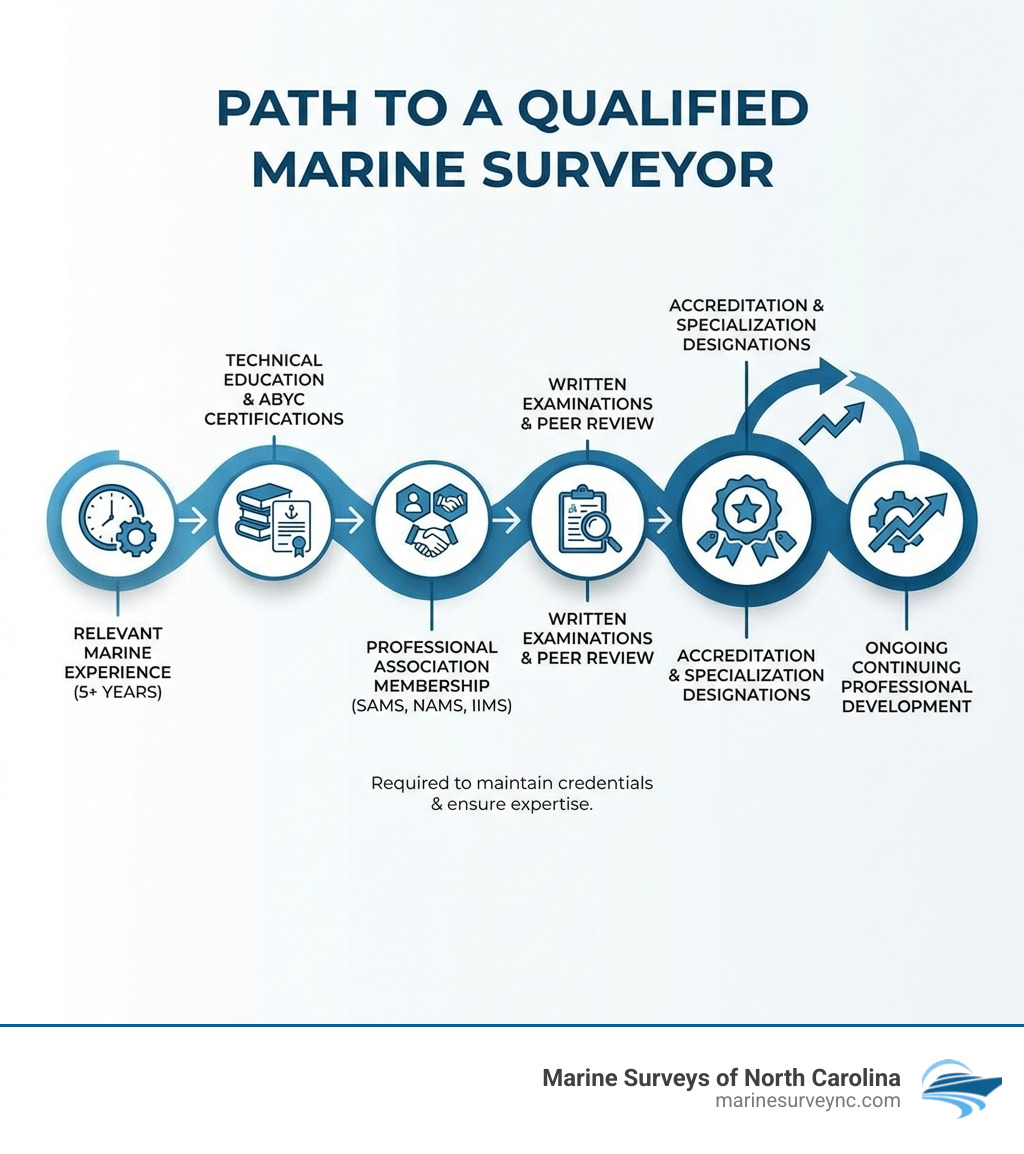
The Accreditation Process: Step-by-Step Overview
Becoming a fully accredited marine surveyor is a journey marked by rigorous evaluation and continuous learning. This multi-faceted process ensures that anyone holding accreditation has had their marine surveyor qualifications thoroughly vetted.

Application and Documentation
The initial step is a comprehensive application detailing an individual’s professional background. This includes submitting a resume, trade references, and anonymized samples of past survey reports. These reports undergo a meticulous peer review by an accreditation committee to assess the applicant’s work skills, reporting clarity, and technical competence. This phase ensures an applicant’s claims of experience are substantiated by verifiable evidence.
Skills and Knowledge Assessment
Once documentation is approved, applicants undergo a rigorous assessment. This typically involves:
- Written Exams: Candidates must pass comprehensive exams testing their knowledge of vessel construction, systems, regulatory compliance, and ethics.
- Peer Review: The review of submitted survey reports serves as a crucial form of practical assessment by experienced, accredited surveyors.
- Committee Interviews: A final interview with a panel of senior surveyors assesses the applicant’s judgment and professional demeanor, ensuring they embody the ethical standards of the profession.
Continuing Professional Development (CPD) and Maintaining Credentials
Accreditation is not a one-time achievement. Surveyors must engage in Continuing Professional Development (CPD) to maintain their credentials, ensuring they remain current with the latest industry advancements, technologies, and regulations. This is typically achieved through annual participation in seminars, workshops, and other educational activities. You can explore examples of these resources here: View educational resources.
Maintaining credentials also requires a steadfast commitment to ethical standards and client confidentiality. The entire accreditation process is designed to sustain a high level of expertise and integrity, which is essential for delivering a reliable Condition & Valuation Survey.
Selecting a Qualified Marine Surveyor: Criteria and Cautions
Choosing the right marine surveyor is a critical decision that impacts your financial security. While referrals are helpful, they should not be the sole basis for your choice. A methodical approach focused on verifying marine surveyor qualifications is essential.
Before hiring, we recommend reviewing our guide: The Savvy Buyer’s Checklist: Essential Boat Inspection Tips. This checklist helps you prepare for the survey process.
Minimum Selection Criteria
When evaluating surveyors in North Carolina, focus on these non-negotiable criteria:
- Verifiable Accreditation: The surveyor must be an accredited member of a recognized association like SAMS or NAMS. Our SAMS SA certification reflects our adherence to these high standards.
- Technical Certifications: Look for certifications from the American Boat and Yacht Council (ABYC), which demonstrate specialized knowledge in critical systems.
- Proof of Insurance: A professional must carry Errors & Omissions (E&O) insurance. Always request proof of current coverage.
How to Verify Credentials
It is your responsibility to verify a surveyor’s credentials.
- Association Directories: Use the online directories of SAMS and NAMS to confirm membership status.
- Sample Reports: Ask for a redacted sample report to assess the thoroughness and clarity of their work.
- References: Request professional references from brokers, yard managers, or previous clients.
Red Flags
Be aware of common red flags to avoid costly mistakes:
- Bargain-Rate Surveyors: Unusually low prices often indicate a rushed job, lack of insurance, or an unqualified individual.
- Surveyors Who Also Perform Repairs: This is a direct conflict of interest that undermines the impartiality of the survey.
- Lack of a Professional Report: A verbal report or simple checklist is not a substitute for a detailed, written document.
- “Virtual” Surveys: A proper survey requires a physical, hands-on inspection. Any offer of a “virtual” survey should be dismissed.
- Fraudulent Claims: Always verify membership claims directly with the professional organization.
- Disqualification Language: A surveyor’s role is to provide facts, even if they are uncomfortable. Be wary of anyone who seems overly eager to gloss over issues or guarantees a vessel will “pass.”
Frequently Asked Questions About Marine Surveyor Qualifications
Here, we address common inquiries regarding marine surveyor qualifications.
What are the key differences in marine surveyor qualifications between membership levels?
Professional organizations like SAMS use membership levels to reflect experience and competence.
- Accredited Marine Surveyor (AMS®): This is the highest surveying membership, requiring at least five years of documented experience and successful completion of rigorous exams. An AMS® is fully accredited and recognized by insurers and lenders.
- Surveyor Associate (SA): This is a professional membership for practicing surveyors working towards AMS® status. They adhere to the same Code of Ethics and continuing education requirements. As a SAMS SA certified firm, we are on this path to the highest level of accreditation.
These distinctions provide transparency about a surveyor’s level of professional vetting. For more details, see the Classifications – The Society of Accredited Marine Surveyors.
How do marine surveyor qualifications impact the survey report timeline?
A qualified surveyor’s experience allows for an efficient yet thorough inspection. For a typical pleasure craft, a comprehensive report is often delivered within three to five business days. However, the timeline can be affected by vessel size, system complexity, and the level of detail required. The priority is always a detailed, written report that serves as a critical record for insurance, financing, and maintenance—not speed. A rushed report is a red flag. To understand the process better, read about What Does a Pre-Purchase Boat Survey in North Carolina Include?.
Why are ABYC certifications critical to a surveyor’s qualifications?
ABYC (American Boat & Yacht Council) certifications are fundamental to ensuring a vessel’s safety and compliance.
- The Industry Standard: ABYC develops the safety standards for boat design, construction, and repair in North America. These standards are often cited in legal disputes as the recognized standard of care.
- Demonstrates Technical Competence: Certifications in areas like marine electrical or diesel engines demonstrate verifiable expertise in complex systems. This allows a surveyor to identify hidden safety hazards and non-compliant installations.
- Reduces Risk: By assessing a vessel against ABYC standards, a certified surveyor helps mitigate risks related to safety, potential damage, and future costs. This proactive identification of issues protects you, the boat owner.
Our commitment to ABYC certifications reflects our dedication to safety and technical accuracy, a principle we also apply in our advice on 5 Essential Maintenance Tips to Prevent Boat Damage.
Conclusion: Ensuring Your Investment is in Capable Hands
The journey to understanding marine surveyor qualifications reveals a landscape where expertise, integrity, and continuous learning are paramount. When considering a vessel purchase, seeking insurance, or assessing damage in North Carolina, the choice of your marine surveyor is not merely a formality; it is a critical decision that directly impacts your financial investment and safety.
We have explored how a qualified marine surveyor is distinguished by a powerful combination of verifiable accreditation from respected organizations like SAMS or NAMS, extensive hands-on experience (often five years or more), rigorous technical certifications from bodies such as ABYC, and a deep understanding of relevant regulatory standards like the US CFRs. These elements, coupled with a steadfast commitment to ethical conduct and ongoing professional development, form the bedrock of a truly competent professional.
The value of engaging a qualified surveyor cannot be overstated. They serve as your eyes and ears, carefully inspecting every accessible aspect of a vessel to uncover hidden issues, assess structural integrity, and evaluate system functionality. This comprehensive approach provides risk mitigation, offering you peace of mind and protecting your investment from unforeseen liabilities and costly repairs.
It is important to acknowledge that not every vessel will meet the stringent insurance or safety standards, and not every buyer is prepared for what a thorough, standards-based survey may uncover. Our role is to provide an objective, fact-based assessment, allowing you to make an informed decision that aligns with your risk tolerance and investment goals.
At Marine Surveys of North Carolina, we pride ourselves on being SAMS SA certified, adhering to the highest industry standards for professionalism, technical competence, and ethical practice. Our commitment is to deliver detailed, unbiased inspections that empower our clients across Wilmington, Beaufort, New Bern, Morehead City, the Outer Banks, and Lake Norman.
To ensure your prospective vessel is evaluated with the highest degree of professionalism, review our process for marine surveys in Wilmington.