Understanding What You’ll Pay for a Marine Survey
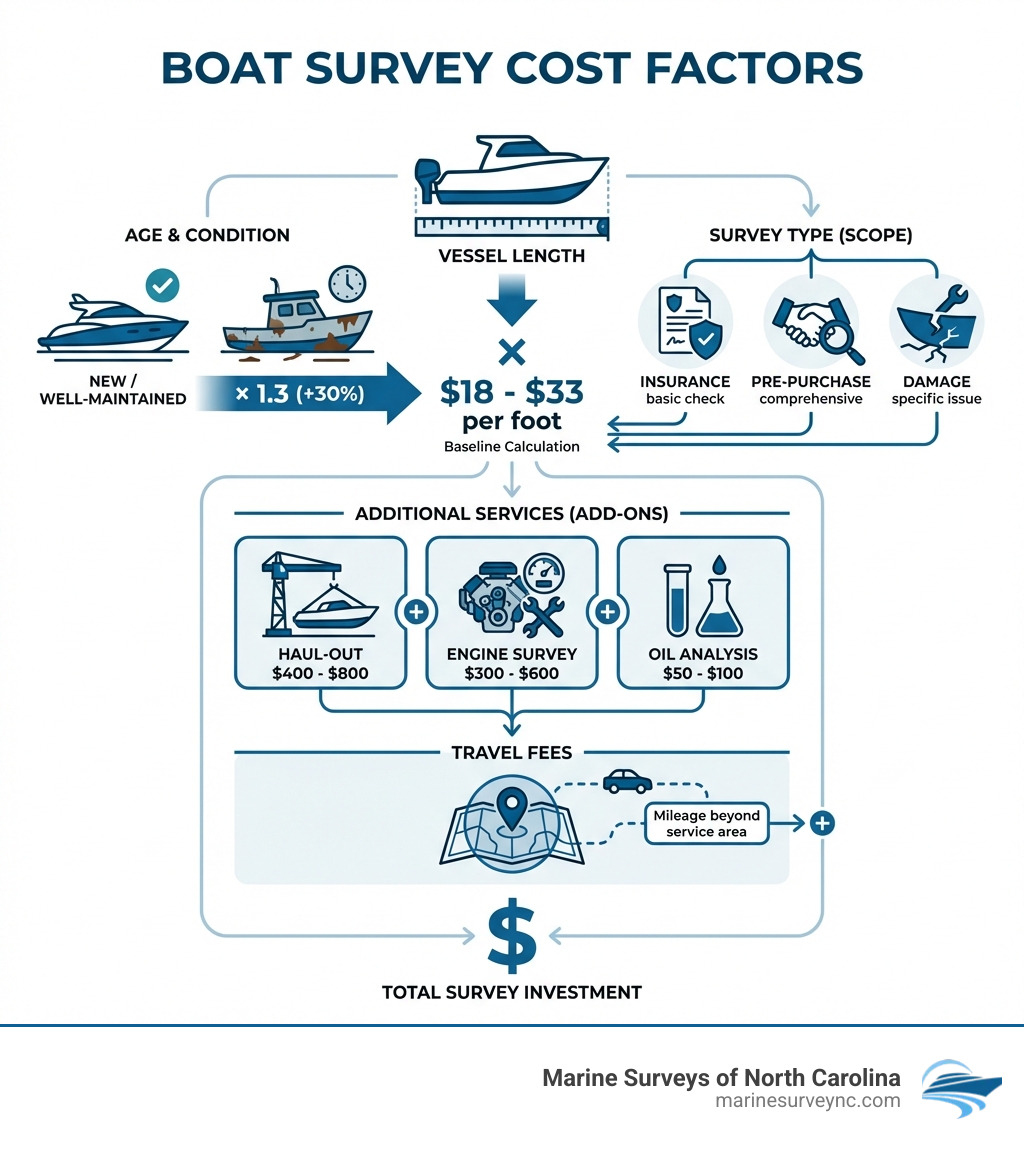
Boat survey cost typically ranges from $18 to $33 per foot of vessel length, depending on the type of survey and complexity of the inspection. Most buyers should budget between $500 and $2,000 for a standard pre-purchase survey, with additional costs for haul-out, engine inspections, and travel fees.
Quick Cost Breakdown:
| Survey Type | Cost per Foot | Typical Range | What’s Included |
|---|---|---|---|
| Insurance Survey | $18-$22 | $450-$1,100 | Condition assessment, basic systems check |
| Pre-Purchase Survey | $22-$28 | $500-$1,400 | Comprehensive inspection, sea trial, out-of-water exam |
| Complete C&V Survey | $28-$33 | $700-$1,650 | Improved inspection for financing/insurance |
Additional Costs to Consider:
- Haul-out and launch: $400-$800
- Engine survey/compression test: $300-$600
- Oil analysis: $50-$100 per sample
- Travel fees: $0.50-$0.66 per mile beyond service radius
When you’re about to make a five- or six-figure investment in a vessel, the survey isn’t an expense—it’s financial protection. A thorough marine survey identifies structural issues, mechanical problems, and safety concerns before you sign the purchase agreement. It gives you negotiating leverage, satisfies insurance and lender requirements, and provides the peace of mind that comes from knowing exactly what you’re buying.
The cost of a survey is almost always less than the cost of the problems it uncovers. A $1,200 survey that reveals a $15,000 engine issue or hidden hull damage has already paid for itself many times over. Beyond the dollars, a professional inspection ensures your family’s safety on the water and protects you from buying someone else’s problem.
I’m Andrew Gallant, a SAMS-certified marine surveyor who has conducted hundreds of vessel inspections across North Carolina’s coastal and inland waterways. Through years of hands-on experience, I’ve seen how boat survey cost concerns can tempt buyers to skip this critical step—and I’ve also seen the expensive consequences when they do. In this guide, I’ll break down exactly what you’ll pay for a marine survey, what factors influence that cost, and why it’s one of the smartest investments you’ll make in the boat-buying process.
The Baseline: Understanding Per-Foot Survey Pricing
The foundation of understanding boat survey cost is typically the per-foot rate. This method provides a clear, scalable estimate based on the vessel’s length overall (LOA). However, this baseline is just a starting point, as various factors will adjust the final price.
What is the average cost of a boat survey per foot?
Across the industry, you can plan on spending around $18 to $25 per foot of boat for a standard marine survey. For more complex vessels or those requiring a more in-depth assessment, such as a “Platinum-Complete C&V Survey,” this rate can increase to $26 to $33 per foot. Many surveyors also have a minimum charge, often ranging from $450 to $500, which applies to smaller vessels where the per-foot rate would fall below this threshold. For instance, a 20-foot boat at $22 per foot would only be $440, so the minimum charge would apply.
These rates reflect the time, expertise, and equipment involved in a thorough inspection. We believe in providing a clear understanding of what a comprehensive Condition & Valuation Survey for Boat Purchase entails, ensuring you know the value you receive for your investment.
How do costs vary for different survey types?
The type of survey you need is a primary driver of the boat survey cost. Not all surveys are created equal, and their scope dictates their price.
-
Pre-Purchase Marine Survey: This is the most comprehensive type of inspection, and typically carries a higher per-foot rate, often between $22 and $28 per foot. It includes a detailed examination of the vessel’s structural integrity, propulsion system, electrical systems, fuel system, and all onboard components. A critical component is the sea trial, where the vessel’s operational performance is assessed, and an out-of-water inspection, allowing for a thorough evaluation of the hull and underwater gear. Our Pre-Purchase Marine Survey is designed to provide you with a complete picture of the vessel’s condition.
-
Insurance Survey: Also known as a Condition and Valuation (C&V) survey, this type is typically required by insurance companies to assess the vessel’s risk and confirm its value for coverage. These surveys are generally less comprehensive than pre-purchase surveys, focusing on items specified by the insurance provider, and may cost between $18 and $22 per foot. They might not always include a sea trial or a full system operational test. Our Insurance Survey ensures your vessel meets the necessary requirements for coverage.
-
Appraisal Inspection: These surveys determine a vessel’s fair market value for purposes such as financing, estate settlements, or donations. They may have a base price, sometimes around $300, plus an hourly rate.
-
Damage Inspection: Conducted after an incident, these surveys assess the cause and extent of damage, providing repair recommendations and validating repair estimates for insurance claims. Costs for damage inspections can vary widely, sometimes involving expert fees for a full day ($1,200) or half-day ($600), plus hourly consultation rates ($150).
Understanding the distinctions between these types is crucial for budgeting. You can find More info about survey types to help determine which best suits your needs.
Key Factors That Influence Your Final Survey Price
While the per-foot rate provides a good starting estimate, several other factors significantly influence the final boat survey cost. These elements speak to the complexity and logistics involved in assessing a vessel’s true condition.
How do a boat’s age, type, and condition affect the boat survey cost?
The older a vessel, the more complex its systems can become, and the more potential issues it may have accumulated over time. Similarly, a boat in very poor condition or one that has been used as a live-aboard often requires more extensive inspection time. Our research indicates that older vessels, live-aboard vessels, or those in very poor condition can often increase the costs by more than 30%. This is due to the increased time needed for a thorough examination, including more extensive moisture metering, testing of aging components, and documentation of numerous deficiencies.
The type of boat also plays a role. Sailboats, for instance, often require a separate rigging survey, which adds to the overall cost. Multihulls (catamarans, trimarans) have two hulls to inspect, effectively doubling some aspects of the hull survey. Custom-built boats or those with highly complex setups (e.g., advanced electronics, multiple engines, intricate plumbing) demand more specialized knowledge and time, which will be reflected in the final boat survey cost. Preventing hidden issues through proper maintenance can also help manage these costs in the long run; refer to our 5 Essential Maintenance Tips to Prevent Boat Damage.
How do travel expenses and location impact the total cost?
Marine surveyors, like many professionals, account for travel time and expenses. If the vessel is located a significant distance from our primary service areas in North Carolina, such as Wilmington, Beaufort, New Bern, Morehead City, the Outer Banks, or Lake Norman, travel fees will apply. These fees are typically calculated on a per-mile basis, with rates often around $0.50 to $0.66 per mile beyond a certain radius (e.g., 25 miles).
For example, if you’re purchasing a boat in a more remote part of North Carolina, the surveyor’s travel time and mileage will be added to the base survey fee. The availability and proximity of haul-out facilities can also indirectly affect costs, as a surveyor might need to travel further to find a suitable yard for the out-of-water inspection. We strive to provide efficient service across our region, including Marine Surveys in Wilmington and Marine Surveys in New Bern, minimizing unnecessary travel expenses for our clients.
Beyond the Surveyor’s Fee: Budgeting for Associated Costs
A comprehensive marine survey involves more than just the surveyor’s direct fee. Several associated costs are crucial for a thorough inspection and must be factored into your overall budget. These are typically the buyer’s responsibility and are arranged separately.
What are common additional costs for a pre-purchase survey?
The most common and often largest additional cost is the haul-out and launch fee. For a proper out-of-water inspection, the boat must be lifted from the water. This allows us to thoroughly inspect the hull, running gear, rudder, and through-hull fittings. Haul-out costs vary by boat length and marina, but you should budget approximately $400 to $800, with a typical survey haul-out costing around $600. If the hull bottom is dirty, a power wash is often necessary for a clear inspection, which can add approximately $250.
Another significant additional cost can be separate mechanic fees. While we conduct a visual inspection of the engines and propulsion systems, for an in-depth mechanical assessment, especially on complex or high-value engines, we recommend hiring a qualified marine mechanic. This is particularly true for diesel engines. A detailed engine assessment, including a compression test or specialized diagnostics, can add $300 to $600 to the total costs. For larger vessels with multiple engines, hiring a diesel mechanic for a full day could range from $1,500 to $2,000. We also recommend fluid analysis, where oil samples from engines, transmissions, and generators are sent to a lab for testing. These oil samples typically cost $50 each for analysis. Our Engine Systems Review outlines the importance of these inspections.
Other potential additional costs include:
- Rigging Inspection: For sailboats, a professional rigger may be needed to inspect the mast, standing, and running rigging, adding to the cost.
- Corrosion Check: A specialized corrosion check for zinc and metallic underwater fittings can cost upwards of $100 per hour.
- Dismantling/Reassembly: If minor dismantling (e.g., of interior panels) is required to access suspected areas, the cost of qualified personnel to perform this and reassemble it is typically borne by the buyer.
Is a separate engine survey necessary?
For many buyers, especially those considering a vessel with complex engines or high-hour powerplants, a separate engine survey is not just recommended—it’s often essential. While our survey includes a thorough visual inspection and operational check during a sea trial, a specialized marine mechanic possesses the diagnostic tools and in-depth expertise to uncover subtle mechanical issues that could become major expenses.
This is particularly true for high-hour diesel engines, large inboards, or multiple outboard installations. A mechanic can perform compression tests, inspect engine mounts, check cooling and exhaust systems, and conduct specialized diagnostics that go beyond a surveyor’s scope. Given that the most expensive survey findings are often found in the machinery spaces, this additional investment of $300 to $600 for a detailed engine assessment (or more for a full day with a diesel mechanic) is a wise decision. It protects your investment by identifying potential engine overhauls or replacements before you commit to the purchase.
Case Study: Estimating the Survey Cost for a 26-Foot Center Console
Let’s consider a common scenario in North Carolina: estimating the boat survey cost for a 26-foot center console, a popular choice for our coastal waters. This example will illustrate how the various components contribute to the final price.
What is a typical price range for a smaller vessel survey?
For a 26-foot center console, a pre-purchase survey’s base cost, using the typical range of $22 to $28 per foot, would be:
- Low end: $22/foot * 26 feet = $572
- High end: $28/foot * 26 feet = $728
However, this is just the base fee. To get a realistic total, we must factor in the additional, often non-negotiable, costs for a comprehensive inspection in North Carolina:
- Base Survey Fee (Pre-Purchase): We’ll use an average of $650 for our 26-foot example.
- Haul-out and Launch: Budget approximately $500 for this, allowing for variations between marinas in Wilmington, Morehead City, or Beaufort.
- Bottom Power Wash: An additional $250 if the hull is dirty.
- Engine Mechanic Inspection: For a single outboard, a focused inspection and compression test might cost around $350. For twin outboards, this would increase.
- Oil Samples: For a single outboard, one oil sample at $50.
Total Estimated Cost Range for a 26-foot Center Console:
| Cost Component | Estimated Price |
|---|---|
| Base Survey Fee | $650 |
| Haul-out & Launch | $500 |
| Bottom Power Wash | $250 |
| Engine Inspection | $350 |
| Oil Sample | $50 |
| Total Estimated Cost | $1,800 |
This gives us a more realistic total estimate of approximately $1,800 for a thorough pre-purchase survey on a 26-foot center console in North Carolina, assuming a single outboard and including the essential associated services. Prices can fluctuate based on the specific surveyor, the complexity of the vessel (e.g., advanced electronics, multiple systems), and the exact location within our service areas like New Bern or Lake Norman. While some users in online forums reported quotes as high as $1,500 for a 26-foot CC, and others paid as low as $425 for a basic survey without motor diagnostics, our comprehensive approach aims to provide maximum protection. We also offer a Preliminary Survey option for initial assessments.
Choosing Your Surveyor: How Credentials Impact Cost and Quality
The expertise and credentials of your marine surveyor are paramount, influencing not only the quality of the inspection but also the acceptance of the report by crucial third parties like insurance companies and lenders. While a highly qualified surveyor might have a slightly higher boat survey cost, their value is immeasurable.
Why should you hire a certified marine surveyor?
Hiring a certified marine surveyor is a non-negotiable step in the boat-buying process. Professional organizations such as the Society of Accredited Marine Surveyors (SAMS) and the National Association of Marine Surveyors (NAMS) set rigorous standards for their members. These certifications indicate that the surveyor has met specific experience, education, and ethical requirements, and participates in ongoing continuing education.
Choosing a certified professional ensures:
- Adherence to Standards: Certified surveyors follow established guidelines (such as ABYC and NFPA standards) for inspections and reporting, ensuring consistency and thoroughness.
- Unbiased Reporting: Our allegiance is solely to you, the client. We provide an objective assessment of the vessel’s condition, free from any vested interest in the sale.
- Acceptance by Insurers and Lenders: Insurance companies and financial institutions almost universally require surveys from accredited professionals. A report from a non-certified individual may not be accepted, forcing you to incur the expense of another survey. This is a critical point for anyone seeking financing for their vessel.
- Expertise and Specialization: Certified surveyors often have specialized knowledge in particular vessel types, construction materials, or systems. This expertise is crucial for identifying subtle issues that a less experienced individual might miss.
While some might be tempted by a lower-cost, uncertified option, the potential risks far outweigh the savings. A thorough, credible survey from a certified professional is a testament to our commitment to protecting your investment and ensuring your safety on North Carolina’s waters.
The Bottom Line: Why a Survey is a Critical Investment, Not an Expense
When considering the boat survey cost, it is essential to reframe it not as an expense, but as a critical investment in your financial security and peace of mind. This single step can save you thousands, if not tens of thousands, of dollars in unforeseen repairs and headaches down the line.
How does a survey protect you as a buyer?
A professional marine survey provides several layers of protection:
- Uncovering Hidden Issues: Our detailed inspections are designed to uncover Top 7 Hidden Issues Found in Pre-Purchase Surveys on NC Coast. These can range from structural damage, osmotic blistering, and moisture intrusion in fiberglass hulls to faulty electrical systems, compromised fuel lines, or significant engine wear. Identifying these problems before purchase allows you to either negotiate repairs with the seller, adjust the purchase price, or walk away from a potentially problematic deal.
- Verifying Vessel Condition: Beyond hidden defects, the survey objectively verifies the overall condition of the vessel, ensuring it aligns with the seller’s representations and your expectations. This includes assessing the cosmetic state, functionality of all systems, and the integrity of safety equipment.
- Establishing Fair Market Value: A key component of our survey is providing an estimated fair market value. This valuation gives you solid ground for negotiation, ensuring you don’t overpay for the vessel. It serves as an impartial assessment, vital for making an informed financial decision.
- Avoiding Costly Post-Purchase Repairs: The most compelling reason to invest in a survey is to avoid inheriting someone else’s expensive problems. A $1,000 survey that prevents you from buying a boat needing $10,000 in engine work or $5,000 in electrical repairs is an undeniable bargain. Our aim is to prevent you from being surprised by significant expenses shortly after your purchase.
- Meeting Insurance and Financing Requirements: As previously noted, both insurance providers and lenders almost always require a current marine survey. Without one, you may be unable to insure your vessel or secure a loan, effectively halting your purchase plans.
A survey empowers you to make a truly informed decision. It provides the leverage and knowledge necessary to steer the complexities of a boat purchase with confidence, protecting your investment and ensuring a safer, more enjoyable boating experience on North Carolina’s beautiful waterways.
Conclusion: Making a Confident and Informed Purchase
Understanding boat survey cost is more than just knowing a price per foot; it’s about recognizing the profound value a professional marine survey brings to your vessel acquisition. We’ve seen that while the initial outlay for a survey, including associated costs like haul-outs and specialized mechanical inspections, might seem substantial, it consistently proves to be a wise investment. It acts as your primary defense against unforeseen expenses, safety hazards, and potentially regrettable purchases.
The extensive guide we’ve provided illustrates that a thorough inspection by a certified professional is indispensable. It’s the only way to gain an objective, detailed understanding of a vessel’s true condition, its fair market value, and any potential issues that could impact your enjoyment or financial well-being. Not every vessel, even in our beautiful North Carolina, will meet the necessary insurance or safety standards, and not every buyer is prepared for what a truly comprehensive survey may uncover. Our role is to ensure you are fully informed and prepared for either outcome.
We, Marine Surveys of North Carolina, are proud to offer professional, SAMS SA certified marine surveying services for recreational and power vessels across Wilmington, Beaufort, New Bern, Morehead City, the Outer Banks, and Lake Norman. Our commitment is to provide detailed, unbiased inspections that empower you, the serious buyer, to make a confident and informed purchase, securing your investment and ensuring peace of mind on the water.
We invite you to reach out to us to begin this crucial step in your boat-buying journey. Contact us to discuss your marine survey needs.