Why a Boat Insurance Survey Protects Your Investment
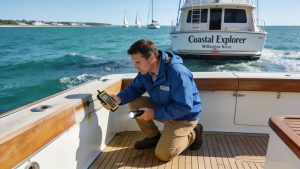
A boat insurance survey is a professional, third-party inspection of a vessel’s condition, systems, and safety features, conducted to help insurance underwriters assess risk and determine insurability. Here’s what you need to know:
Key Facts About Boat Insurance Surveys:
- Purpose: Evaluates structural integrity, safety systems, and fair market value for insurance underwriting decisions
- When Required: Typically mandated for used boats over a certain age (often 10+ years), high-value vessels, or boats of significant length
- Who Conducts Them: Certified marine surveyors certified by organizations like SAMS or NAMS
- Cost: Generally $20–$25 per foot of boat length, with minimum fees for smaller vessels
- Duration: Ranges from a few hours for small boats to a full day or more for larger yachts
- Who Pays: The boat owner or prospective buyer, even when required by the insurer
- Outcome: A detailed report documenting condition, safety compliance, recommended repairs, and appraised value
Insurance companies require these surveys because boats present unique risks. Unlike cars or homes, vessels operate in harsh, unregulated environments where hidden damage can lead to catastrophic loss. A twenty-four-foot boat might look fine on the surface, but a surveyor could uncover delaminated core material, corroded fuel tanks, or electrical systems that pose fire risks—issues that would make the vessel uninsurable without remediation.
The ocean is regulation-less and unforgiving. Repair costs for marine systems are notoriously high, and discrepancies in a boat’s market value are common, especially for older or custom-modified vessels. Insurers use surveys to avoid covering pre-existing damage and to ensure they’re not insuring a vessel worth far less—or more—than the owner claims.
I’m Andrew Gallant, a SAMS-certified marine surveyor with Marine Surveys of North Carolina, and I’ve conducted hundreds of insurance surveys across coastal and inland waterways. Through my work, I’ve seen how a thorough boat insurance survey protects both the vessel owner and the underwriter by identifying hidden risks before they become expensive claims.
In the sections that follow, we’ll walk through what a boat insurance survey actually entails, how it differs from a pre-purchase inspection, what triggers the requirement, and how to find a qualified surveyor who will deliver the unbiased, detailed report your insurer needs.
What is a Marine Survey and Why is it Crucial for Boat Insurance?
A marine survey is a professional, detailed inspection of a vessel’s condition, seaworthiness, safety, and market value. It is a statement of opinion from a professional marine surveyor about the condition and value of a vessel based upon their detailed first-hand inspection. This technical investigation digs into the construction, condition, components, and systems of a boat at a particular moment in time. The product of a marine surveyor is a comprehensive written report, which serves various purposes, especially for insurance.
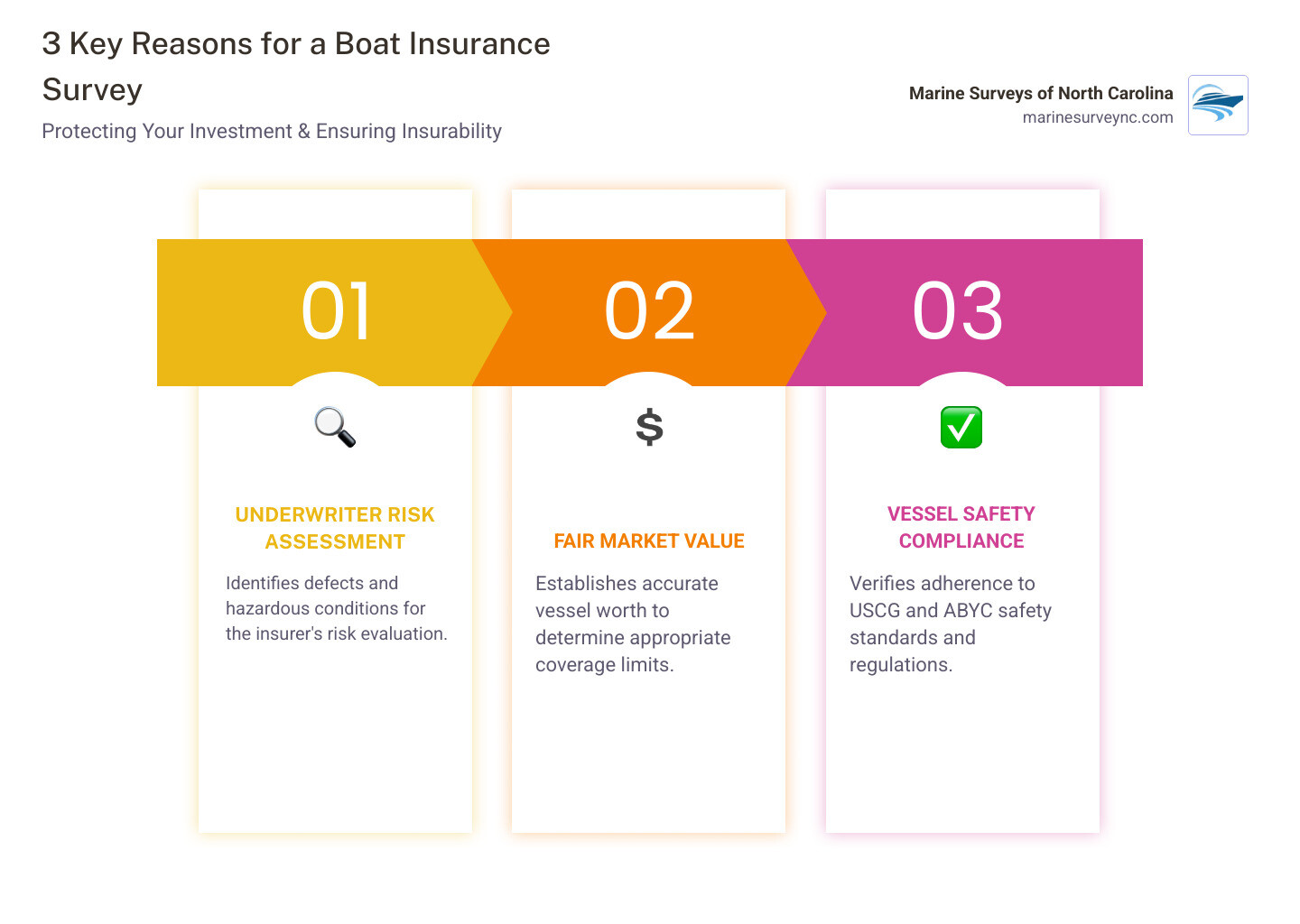
From an underwriter’s perspective, a boat insurance survey is a critical tool for risk mitigation. Insurers often require a survey to assist them in making informed underwriting decisions. This allows them to identify potential defects, existing damages, or hazardous conditions that could pose a threat to safety or lead to future loss. Without this unbiased assessment, an insurance company would be taking on unknown risks, which could result in higher premiums or even a refusal to offer coverage.
Our role as SAMS SA certified marine surveyors is to provide an impartial assessment, ensuring that the vessel’s condition, seaworthiness, and estimated value are accurately documented. This helps in establishing an insurable value, protecting both your investment and the insurer’s interests. For us, establishing the Fair Market Value (FMV) is a key component, as it guides the insurance coverage limits. We adhere to recognized standards such as the American Boat & Yacht Council (ABYC) standards, which are widely accepted as the authoritative reference for evaluating issues of design, construction, maintenance, and product performance in the marine industry. These standards often exceed Coast Guard requirements, providing an additional layer of safety and reliability.
A thorough boat insurance survey uncovers hidden defects that an untrained eye might miss, offering you, the owner, peace of mind. It ensures that any necessary upgrades or repairs for safe operation are identified, thus safeguarding your investment and preventing potentially catastrophic failures at sea. For more information on how a detailed inspection can protect your interests, you can review our insights on Condition and Valuation Survey for Boat Purchase.
The Boat Insurance Survey Process: What to Expect
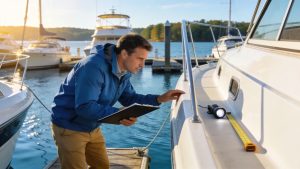
When you engage us for a boat insurance survey, you are initiating a methodical and comprehensive process designed to leave no stone unturned. Our approach typically involves several stages to ensure a complete evaluation of your vessel.

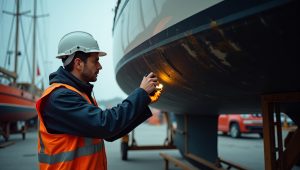
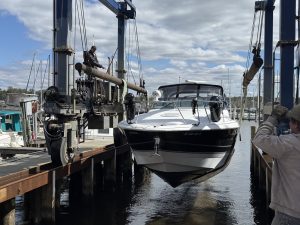
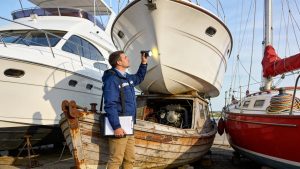
The process begins with a detailed static inspection, examining the vessel both in and out of the water. A haul-out inspection is often crucial for older vessels or new policies, allowing us to thoroughly inspect the hull, running gear, and underwater components that are otherwise hidden. Following the haul-out, an in-water inspection covers the vessel’s systems and structure while it is afloat. For many surveys, particularly pre-purchase, a sea trial is also coordinated. This allows us to observe the vessel’s performance underway, checking engine function, steering, electronics, and overall handling in its operating environment. We ensure transparent communication throughout this professional process, working with boatyards and captains across North Carolina, from Wilmington to Lake Norman, to facilitate a smooth and efficient survey.
What’s Included in a Typical Boat Insurance Survey Checklist?
A comprehensive boat insurance survey involves a detailed checklist to ensure all critical components of your vessel are carefully examined. While the exact scope can vary slightly based on the vessel type and specific insurance requirements, our surveys typically cover:
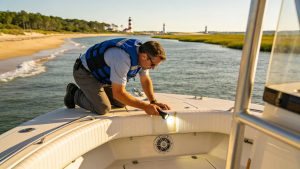
- Hull and Structure: We conduct a thorough inspection of the hull, both above and below the waterline (during haul-out). This includes checking for signs of delamination, osmotic blistering, stress cracks, and proper fairing. We also assess the integrity of bulkheads, stringers, and internal structural components where accessible.
- Deck Condition: We examine the deck for soft spots, evidence of core saturation, and the condition of non-skid surfaces, hardware, and through-deck fittings.
- Mechanical Systems: This covers a broad range, including propulsion machinery (main engines), auxiliary generators, and associated components. We note model and serial numbers, engine hours, and visually inspect for leaks, corrosion, and the general state of maintenance. While we are not mechanics, we assess the overall condition and recommend specialized mechanical inspections where necessary.
- Electrical Systems (AC/DC): We review the vessel’s electrical wiring, panels, battery installations, charging systems, and circuit protection for compliance with safety standards. We check AC polarity and the general condition of insulation and connections.
- Fuel and Plumbing Systems: The integrity of fuel systems is paramount due to fire, explosion, and pollution hazards. We inspect tanks, lines, filters, and ventilation. For plumbing, we check for watertight integrity, corrosion resistance of materials, and proper design to prevent hazards like reverse siphoning. This includes sea cocks, strainers, hoses, bilge pumps, and sanitation systems.
- Thru-hulls and Seacocks: These critical components are carefully inspected for corrosion, proper installation, and operational function.
- USCG Safety Equipment Compliance: We verify the presence and condition of mandatory safety equipment, such as life jackets, fire extinguishers, flares, sound-producing devices, and navigation lights, ensuring they meet U.S. Coast Guard requirements.
Our objective is to provide a detailed, referenced, and photo-documented report that gives both you and your insurance underwriter a clear picture of the vessel’s condition. For a deeper dive into the specifics of what we look for, you can refer to our guide on What Does a Pre-Purchase Boat Survey in North Carolina Include?.
Cost, Duration, and Responsibility
Understanding the practical aspects of a boat insurance survey is crucial for planning. The cost and duration are influenced by several factors, and the responsibility for payment typically falls to the buyer or owner.
The typical cost for a marine survey, including those for insurance purposes, is generally around $20 to $25 per foot of boat length. However, many surveyors, including ourselves, have a minimum fee for smaller vessels to cover the inherent overhead of a professional inspection. For instance, a 50-foot boat might cost anywhere from $1,000 to $1,250. This fee structure reflects the extensive time, expertise, and equipment involved in a thorough inspection. Additional services, such as specialized mechanical, electrical, engine oil testing, or a rig survey for a sailboat, may incur extra costs and should always be discussed upfront.
The duration of a survey can vary significantly. A smaller vessel might take a couple of hours, while a mid-sized boat could require several hours. Larger yachts or complex vessels, particularly those needing a comprehensive pre-purchase survey with a haul-out and sea trial, can take a full day or even several days for mega-yachts. Factors such as the vessel’s age, its condition, the type of survey requested, and the surveyor’s preparation time all play a role. We always recommend discussing a realistic timeline with us beforehand.
Regarding who pays, the buyer or current owner is typically responsible for the cost of the marine survey, even if it is required by a lender or insurance company. Insurance companies do not cover the cost of a survey needed to satisfy their requirements, as it is considered part of the due diligence process for the policyholder.
It is important to note that you cannot conduct your own marine survey for insurance purposes. If a survey is required by your insurer, they will invariably require it to be performed by an certified or licensed professional. This ensures an unbiased, expert assessment, as an owner’s self-assessment would naturally lack the impartiality and technical depth demanded by underwriters.
Navigating the Different Types of Marine Surveys
The world of marine surveying offers various types of inspections, each custom to specific needs and objectives. While all share the common goal of assessing a vessel, their scope, primary user, and outcome differ significantly. Understanding these distinctions is key to requesting the appropriate service.
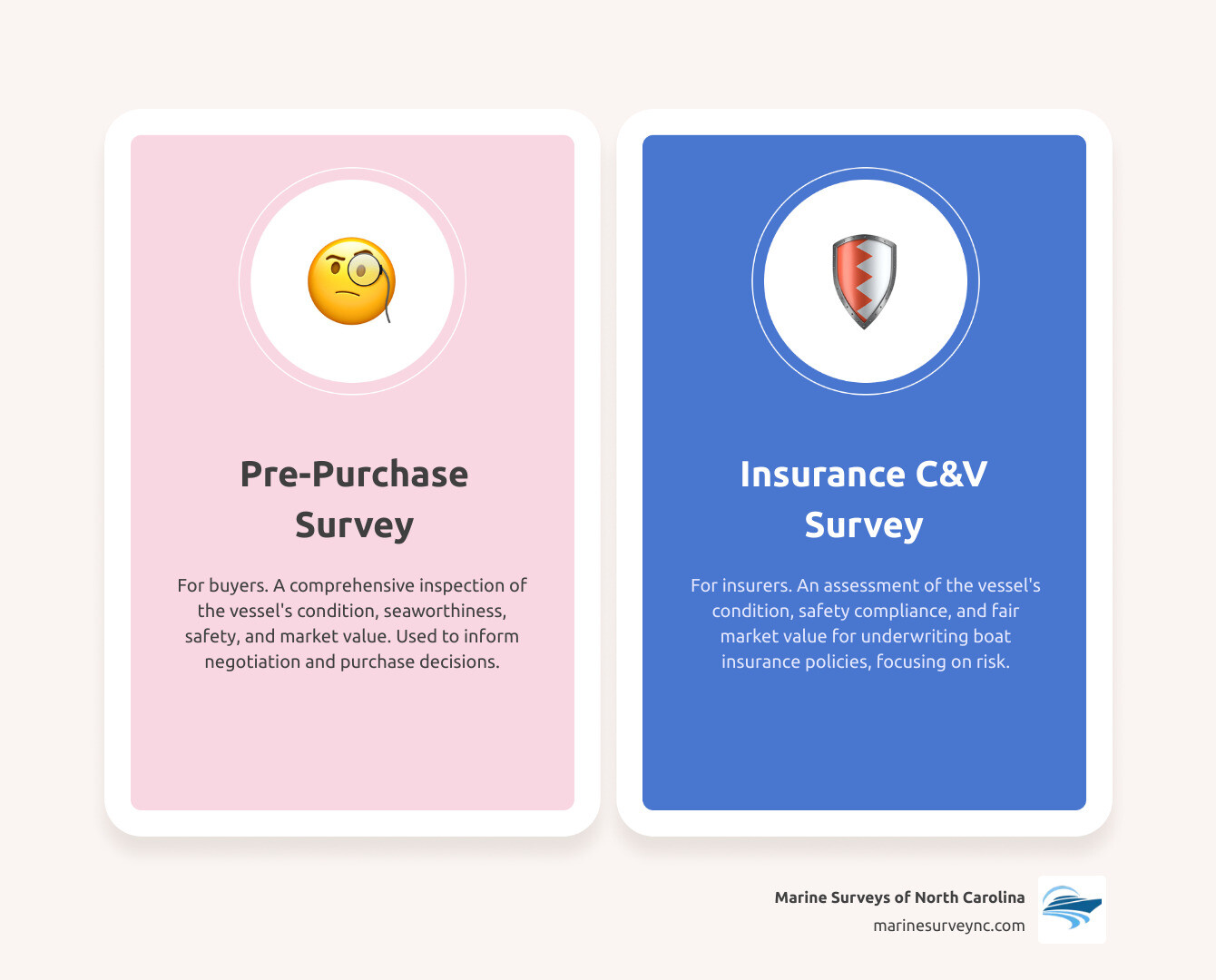
Here’s a comparison of the two most common types:
| Feature | Pre-Purchase Survey to use a marine surveyor to find any hidden problems with the boat.
| Scope |
| Scope | Comprehensive inspection of the vessel’s condition, seaworthiness, safety, and market value. Includes hull, deck, mechanical, electrical, fuel, plumbing, safety equipment, and typically a sea trial. Used to inform the buyer of the true condition of the boat. |
| Primary User | Buyer of the vessel. |
| Primary User | Insurance company for boat insurance survey purposes. |
| Primary User | Buyer of the vessel. |
| Primary User | Insurance company for boat insurance survey purposes. |
| Outcome | Detailed report on the vessel’s condition, seaworthiness, and estimated value. Provides a basis for negotiation and purchase decisions. |
Beyond these primary inspections, we also conduct other specialized surveys that serious boat owners may encounter.
Pre-Purchase Survey vs. Insurance Survey: Key Differences
While both a pre-purchase survey and a boat insurance survey (often called an Insurance Condition & Value or C&V survey) involve a thorough inspection, their core purposes, depth of detail, and intended audiences differ significantly.
A Pre-Purchase Survey is the most comprehensive type of inspection, designed entirely for the buyer’s benefit. Our goal during a pre-purchase survey is to provide you with the most complete and unbiased understanding of the vessel’s condition, seaworthiness, and overall value before you commit to a purchase. This includes an in-depth examination of the hull, deck, mechanical systems, electrical systems, safety equipment, and typically involves a haul-out and a sea trial. The detailed findings can serve as a powerful negotiation tool, allowing you to request repairs or adjust the purchase price based on any issues we uncover. It’s your due diligence, helping you avoid costly surprises down the line. We provide these services across North Carolina, including Pre-Purchase Boat Survey North Carolina for all vessel types.
In contrast, an Insurance Survey is specifically commissioned by the insurance company. While it still assesses condition and value, its scope is more focused on the insurer’s checklist and their risk assessment criteria. The primary aim is to determine if the vessel is an acceptable risk for coverage and to establish its current fair market value for policy limits. These surveys may not always include a sea trial or be as exhaustive in detailing every minor cosmetic flaw, as the underwriter is primarily concerned with structural integrity, safety, and compliance with standards. Our Insurance Survey service is designed to meet these precise requirements, providing the insurer with the necessary information to make their underwriting decision.
The crucial distinction is that an insurance survey should never be used as a substitute for a pre-purchase survey. While it provides valuable information, it may not be sufficiently detailed to inform a major purchase decision or uncover all potential issues that could impact your long-term ownership experience.
Other Common Surveys You Might Encounter
Beyond the essential pre-purchase and insurance surveys, several other specialized inspections cater to different needs:
- Appraisal Survey: This type of survey is conducted solely to determine the fair market value of a vessel. It is often required for financing, estate settlements, divorce proceedings, charitable donations, or legal cases where an objective valuation is needed. Our report will detail the vessel’s features, condition, and provide a justified valuation based on market data.
- Damage Survey: In the unfortunate event of an accident, collision, or peril (such as storm damage), a damage survey is essential. We assess the extent of the damage, investigate the probable cause, recommend the necessary repairs, and validate repair estimates. This report is crucial for insurance claims and helps ensure the vessel is restored to its pre-damage condition. You can learn more about this specialized service on our Damage Surveys page.
- Walk-Through Inspection / Preliminary Survey: For out-of-town buyers or those narrowing down options, a preliminary survey or walk-through inspection provides a verbal-only assessment with photos. This is a cost-effective way to get a professional opinion on a vessel’s general suitability before committing to a full, comprehensive survey and travel expenses. We offer this service across our North Carolina locations, helping clients decide if a boat is worth further investigation.
Each survey type serves a distinct purpose, and choosing the right one ensures you receive the specific information you need for your unique situation.
The Aftermath: Interpreting and Acting on Survey Findings
Once we complete our inspection, the culmination of our work is a detailed survey report. This document is far more than just a checklist; it’s a comprehensive narrative, often delivered in PDF format, outlining our findings and providing actionable recommendations.
Our reports are typically delivered via email in PDF format within 48 hours of the survey completion. They include a list of findings, often prioritized by urgency, and recommendations for any necessary repairs or maintenance. This report is your roadmap to understanding the vessel’s true condition.
When is a Boat Insurance Survey Required?
The requirement for a boat insurance survey is not universal, but it is very common, especially for certain types of vessels. Insurance companies use specific triggers to determine when a survey is mandatory:
- Vessel Age: This is perhaps the most common trigger. Many insurers require a survey for boats over a certain age, often 10 years or older. As boats age, wear and tear, corrosion, and potential structural issues become more prevalent, increasing the risk for the underwriter. For older boats, an insurance company might require a survey every 3-5 years for continued coverage.
- Vessel Length: Larger boats generally represent a higher financial risk. Insurers may mandate surveys for vessels exceeding a certain length, such as 26 feet or more.
- High Value: Regardless of age or length, a boat with a high declared value will almost certainly require a survey to confirm its condition and appraised value.
- Construction Material: Certain construction materials, like wooden hulls, may trigger more frequent survey requirements due to their susceptibility to specific issues like rot or water damage.
- Past Claims or Damage: If a vessel has a history of significant insurance claims or reported damage, an insurer will likely require a survey to ensure all issues have been properly addressed and the boat is fully restored to a safe and insurable condition.
Can you get boat insurance without a survey? Yes, under specific circumstances. Newer boats, typically those 1-2 years old, might not require a survey, as their market price can often be determined by a sales receipt. Additionally, if you are only seeking liability insurance, which covers damage to others but not your own vessel, a survey may not be necessary. However, for comprehensive coverage on most used boats, especially those that fit the criteria above, a boat insurance survey will be a prerequisite. It’s always best to ask your boat insurance provider directly about their specific requirements for your vessel.
What Happens if the Survey Uncovers Issues?
It is not uncommon for a marine survey to uncover issues, even on well-maintained vessels. Our role is to identify and report these findings objectively. What happens next depends on the nature of the issues and your insurance provider’s policies.
Our reports will clearly outline any mandatory findings, especially those related to safety or structural integrity. These will often be accompanied by specific safety recommendations. For instance, a delaminated rudder or issues with crevice corrosion could be identified. Your insurer will review these findings and may respond in several ways:
- Required Repairs: For critical safety or structural issues, the insurance company will likely require that specific repairs be completed and verified (sometimes with a follow-up inspection) before they will bind a policy or renew coverage.
- Premium Adjustments: If minor issues are found that don’t compromise safety but indicate increased risk, your insurer might adjust your premium accordingly.
- Declining Coverage: In severe cases, if the vessel is deemed unseaworthy, unsafe, or requires extensive, costly repairs that you are unwilling to undertake, the insurance company may decline to offer coverage.
- Negotiation: If the survey was part of a pre-purchase process, these findings provide leverage for you to negotiate with the seller for repairs or a reduction in price.
The validity period of a boat insurance survey report is often a point of inquiry. While a survey doesn’t technically “expire,” its relevance diminishes over time as a vessel’s condition can change. Lenders or insurers typically require a survey to have been completed within the last two years. However, if the boat has undergone significant alterations, been involved in an incident, or its condition has visibly deteriorated, a new survey may be required sooner. The ultimate discretion on the validity and acceptance of a report rests with the individual insurer.
Finding a Qualified Surveyor and Understanding the Report
Choosing the right marine surveyor is a critical step in protecting your investment and ensuring your vessel is insurable. The marine surveying industry, while vital, is not federally regulated or licensed, which means anyone can claim to be a surveyor. This lack of regulation underscores the paramount importance of selecting a professional with verifiable credentials and experience.
How to Find a Professional Marine Surveyor
To ensure you receive a competent and unbiased assessment, we strongly recommend seeking out a professional marine surveyor. Professional organizations play a crucial role in upholding standards and certifying qualified individuals.
The two leading professional organizations for marine surveyors in the United States are:
- The Society of Professional Marine Surveyors (SAMS)
- The National Association of Marine Surveyors (NAMS)
These organizations require their members to meet strict technical and ethical standards, undergo rigorous training, and participate in continuing education. As a SAMS SA certified marine surveyor with Marine Surveys of North Carolina, we uphold these high standards.
When vetting a surveyor, always verify their certification. You can typically find directories of certified surveyors on the SAMS and NAMS websites. We serve clients across North Carolina, including Marine Surveys in Wilmington, Beaufort, New Bern, Morehead City, the Outer Banks, and Lake Norman. When selecting us, you are choosing a professional committed to providing a thorough, impartial inspection.
Understanding the Survey Report
Once your boat insurance survey is complete, you will receive a comprehensive report. Understanding its structure and content is essential for interpreting the findings and taking appropriate action.
A typical survey report is clear, concise, and well-organized. It will begin with Vessel Identification and Specifications, including the builder, model, year, vessel type, hull number, registration, and principal dimensions. This section establishes the basic details of the boat.
The heart of the report lies in the Findings Section. Here, we detail the condition of various systems and components, such as the hull, deck, mechanical, electrical, fuel, and plumbing systems. Crucially, this section includes Prioritized Recommendations. These recommendations are statements of fact regarding deficient, substandard, or dangerous conditions, along with suggestions on how to restore them to an acceptable state. We prioritize these based on urgency, distinguishing between “immediate” safety concerns and those that can be addressed within 30, 60, or 90 days.
The Valuation Section provides our professional opinion on the vessel’s Fair Market Value (FMV) and, in some cases, its replacement cost. The FMV is the most probable price a boat would bring in a competitive and open market, considering its condition, location, and recent sales data. Insurance value and market value are not always identical, as market value can be influenced by factors beyond an insurer’s immediate concern, such as custom upgrades that do not necessarily increase the vessel’s overall market appeal.
Finally, the report will include a Statement of Limitations. This section clarifies what was and was not inspected, the parameters of the survey, and any disclaimers, such as the fact that the report is a “snapshot in time” and that the surveyor is not an underwriter, therefore refraining from making statements about insurability. Our reports are designed to be thorough, objective, and easy to understand, providing you with the clarity needed to make informed decisions about your vessel and its insurance.
Conclusion: Protecting Your Investment with a Professional Survey
In the complex world of boat ownership, a boat insurance survey stands as a non-negotiable safeguard. We have seen how this professional assessment is crucial for both risk management and informed decision-making, protecting your significant investment in a vessel. From identifying hidden structural flaws and ensuring compliance with safety standards to accurately determining fair market value for underwriters, the survey provides an invaluable layer of security.
Not every vessel will meet the rigorous standards for insurance or safety, and a thorough survey may uncover issues that impact your purchase or ownership decisions. These inspections are neither quick nor inexpensive, but they represent a vital investment in your peace of mind and financial security on the water.
At Marine Surveys of North Carolina, we are dedicated to providing professional, SAMS SA certified marine surveying services for recreational and power vessels across our beautiful state, including Wilmington, Beaufort, New Bern, Morehead City, the Outer Banks, and Lake Norman. Our detailed, unbiased inspections are designed to give you clarity, whether you are buying, insuring, or assessing damage.
We invite serious buyers and boat owners to Contact us to discuss your vessel and determine the appropriate survey for your needs. Let us help you steer the complexities of marine ownership with confidence and expertise.