Why a Condition and Value Survey Matters Before You Buy or Insure
A condition and value survey is a professional inspection that evaluates a vessel’s structural integrity, onboard systems, safety equipment, and fair market value—typically required by insurance companies to determine if a boat is an acceptable risk, especially for older vessels.
What a Condition and Value Survey Covers:
- Structural assessment: Hull integrity, deck, bulkheads, and construction quality
- Systems inspection: Propulsion machinery, electrical, fuel, plumbing, and navigation equipment
- Safety evaluation: USCG-required equipment, fire suppression, and compliance with ABYC and NFPA standards
- Fair market valuation: Appraisal based on condition, comparable sales, and geographic location
- Deficiency reporting: Documented list of repairs needed, prioritized by urgency
One of the most disappointing moments in the boat buying experience is when you show up at the boat and find that the photos do not appear to be the same vessel you are looking at. Even when sellers act in good faith, critical issues often remain hidden beneath fiberglass, behind electrical panels, or deep within fuel and propulsion systems.
A condition and value survey provides the documented evidence insurers, lenders, and serious buyers need to make informed decisions. It identifies safety hazards, estimates repair costs, and establishes whether a vessel meets regulatory standards. For many buyers, it’s the last opportunity to uncover costly problems before a purchase becomes permanent.
The survey also serves a dual purpose: it protects your financial investment while demonstrating to underwriters that the vessel is seaworthy and insurable. Most insurance companies require surveys on older boats, and many lenders won’t approve financing without one. Without this inspection, you’re making a six-figure decision based on incomplete information.
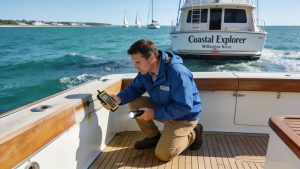
I’m Andrew Gallant, a SAMS Surveyor Associate marine surveyor at Marine Surveys of North Carolina. I conduct condition and value surveys across the state’s coastal and inland waterways, providing unbiased vessel evaluations that meet insurance, lender, and regulatory requirements.
Understanding the Condition and Value Survey
In the maritime industry, a condition and value survey (often abbreviated as a C&V survey) is frequently referred to as an insurance survey. Its primary function is to provide an insurance underwriter or a financial lender with a clear, unbiased picture of the vessel’s current state and its monetary worth.
When we step aboard a vessel in Wilmington or Morehead City, we aren’t just looking for aesthetic wear. We are conducting a methodical evaluation to determine if the boat is “an acceptable risk.” This means assessing its seaworthiness—the vessel’s ability to safely steer its intended waters without endangering the crew or the environment.
A critical part of this process involves verifying compliance with mandatory and voluntary safety standards. We reference three primary authorities:
- United States Coast Guard (USCG): Federal requirements for safety equipment, such as life jackets, flares, and fire extinguishers.
- National Fire Protection Association (NFPA): Specifically NFPA 302, which provides fire protection standards for pleasure and commercial motor craft.
- American Boat and Yacht Council (ABYC): These are the industry’s most rigorous voluntary standards covering everything from electrical wiring to fuel system installation. ABYC technical standards and safety guidelines are the benchmark we use to identify potential hazards that could lead to fire, sinking, or personal injury.
Primary Purposes of a C&V Inspection
The condition and value survey is not merely a “check-the-box” requirement; it is a vital tool for risk mitigation.
- Risk Assessment for Insurers: Insurance companies use the report to decide whether to issue a policy and at what premium. They are looking for “latent defects”—problems that aren’t obvious to the untrained eye but could result in a claim.
- Loan Collateral Verification: If you are financing a yacht in Beaufort or New Bern, the bank needs to know that the asset is worth the loan amount. The C&V survey establishes the Fair Market Value (FMV) to ensure the collateral is sufficient.
- Safety Verification: We identify high-priority safety issues, such as AC polarity problems, fuel leaks, or outdated fire suppression systems. Understanding the purpose of a marine survey is about recognizing that your safety on the water is the ultimate priority.
- Identifying Hazards: We look for structural vulnerabilities or system failures that could lead to marine casualties. For example, a survey might reveal inadequacies in a commercial vessel’s fire suppression or structural vulnerabilities in a recreational boat’s hull.
Comparing Survey Types: C&V vs. Pre-Purchase and Appraisal
It is common for boat owners to confuse the different types of surveys available. While they share some similarities, their scope and depth vary significantly.
| Feature | Condition & Value (C&V) | Pre-Purchase Survey | Appraisal Survey |
|---|---|---|---|
| Primary Goal | Insurance/Financing | Buying Decision | Estate/Legal/Donation |
| Scope of Work | Structural & Safety Focus | Comprehensive (All Systems) | Valuation Focus |
| Sea Trial | Optional/Limited | Standard & Thorough | Rarely Included |
| Operational Testing | Basic Systems | Detailed Load Testing | Limited |
| Suitability | Underwriting Requirements | Informed Purchase | Tax or Legal Evidence |
A pre-purchase marine survey is the most comprehensive inspection we offer. It includes a sea trial and detailed operational testing of every component, from the air conditioning to the navigation electronics. In contrast, a standard condition and value survey is often a “limited” version focused on what the insurance company needs to know: Is it safe, and what is it worth?
Damage surveys are another specialized category. These are conducted after an incident—like a collision or storm damage—to determine the cause, nature, and extent of the damage for insurance claims. Appraisals, on the other hand, are often used for estate settlements, divorces, or charitable donations where the physical condition is less about seaworthiness and more about establishing a defensible dollar amount.
Essential Components of a Condition and Value Survey
To provide an accurate C&V survey for boat purchases or insurance renewals, we evaluate several core categories:
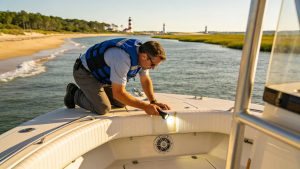
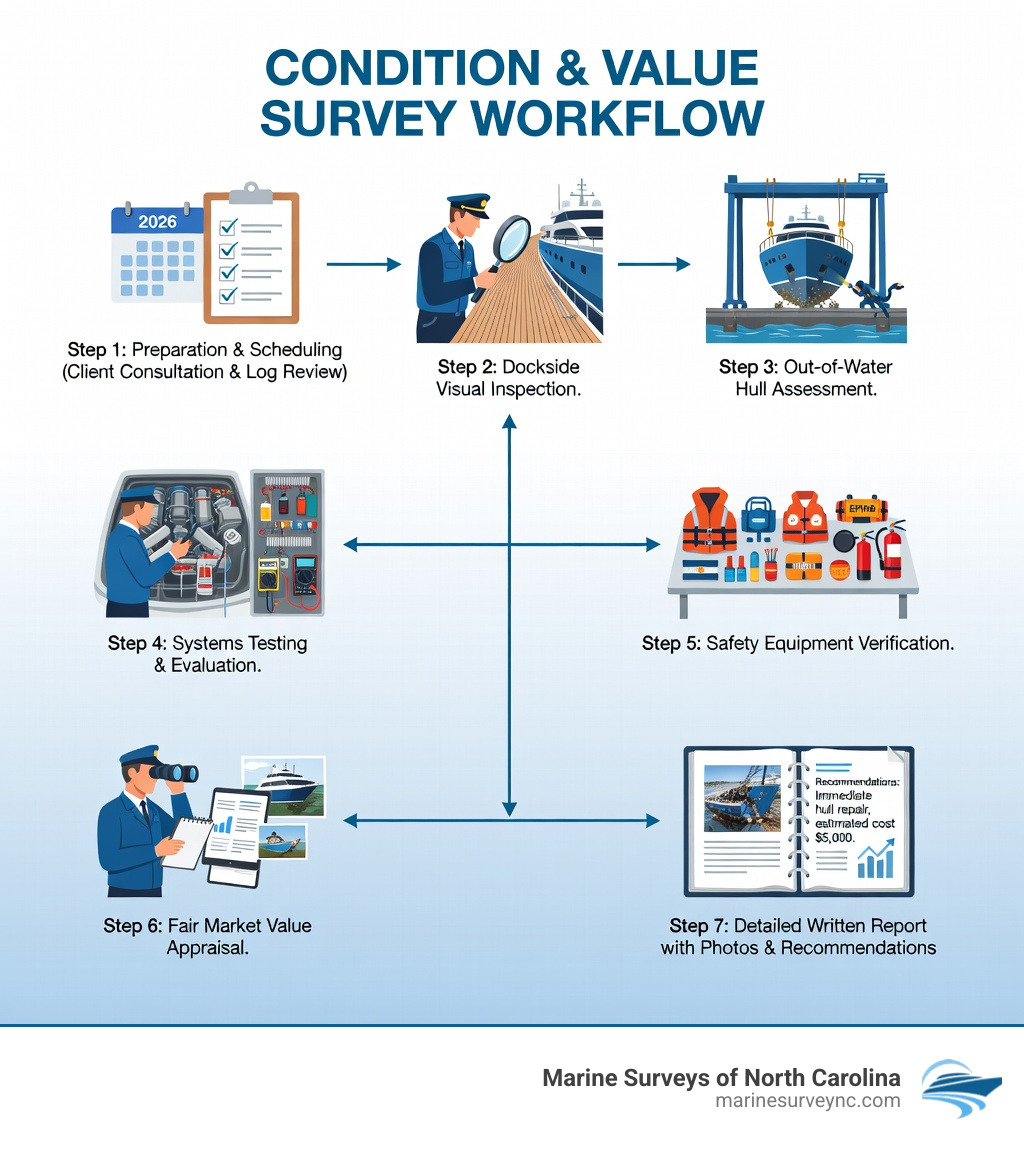
- Hull and Deck Integrity: We inspect the laminate for signs of moisture, delamination, or osmosis (blistering). This often requires an out-of-water inspection.
- Propulsion Machinery: We check the engine(s), transmission, and generator for leaks, corrosion, and proper mounting. While we aren’t engine mechanics, we look for visual cues of poor maintenance or impending failure.
- Electrical Systems: This is where many safety hazards reside. We check the DC battery systems and AC shore power connections, looking for improper wiring or “shade-tree” repairs that violate ABYC standards.
- Fuel and Plumbing: We verify that fuel tanks are secure and lines are made of the correct material. We also test bilge pumps and through-hull fittings to ensure the boat stays dry.
- Safety Equipment Inventory: We document the presence and expiration dates of flares, fire extinguishers, and life rafts, ensuring they meet USCG mandates.
The Inspection Process and Methodology
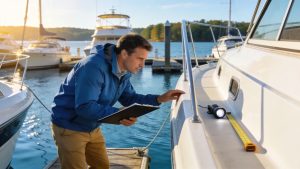
The process begins with preparation. For a survey in the Outer Banks or Lake Norman, we ask owners to have all ship’s papers ready and to ensure the bilge is clean and dry. Access is key; the more equipment and “clutter” that is moved out of the way, the more thorough we can be.

Dockside and Out-of-Water Assessment
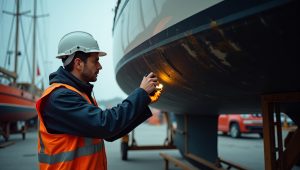
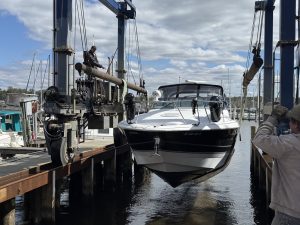
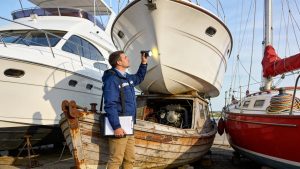
The survey typically starts at the dock with a visual inspection of the interior and systems. However, a true condition and value survey requires an out-of-water assessment. This allows us to inspect the “running gear”—the propellers, shafts, struts, and rudders—and the wetted surface of the hull.
Technical Testing Methods
We use specialized tools to see what the eye cannot:
- Structural Percussion Testing: Using a specialized phenolic hammer, we “sound” the hull and deck. A sharp “crack” indicates solid laminate, while a dull “thud” can signal delamination or core rot.
- Moisture Evaluation: We use moisture meters to detect water intrusion in cored fiberglass structures, which can lead to structural failure if left unaddressed.
- Thermal Imaging: Infrared thermography allows us to find “hot spots” in electrical panels or hidden moisture in the hull without destructive testing.
Determining Fair Market Value and Regulatory Compliance
One of the most critical parts of the report is the Fair Market Value (FMV). According to the IRS, FMV is the price that property would sell for on the open market between a willing buyer and a willing seller, neither being required to act, and both having reasonable knowledge of the relevant facts.
To determine this, we don’t just look at what you paid or what the “book” says. We consider:
- Comparable Sales: What have similar vessels actually sold for recently in the North Carolina market?
- Condition: A well-maintained boat in Wrightsville Beach is worth significantly more than a neglected one of the same year and model.
- Geographic Location: Boat values can fluctuate based on regional demand.
- Replacement Cost: What would it cost to buy this boat new today, adjusted for depreciation and obsolescence?
For those donating a vessel, the IRS guidance on determining the value of donated property emphasizes that for boats, the physical condition is so critical that an appraisal by a marine surveyor is highly recommended. We provide a professional opinion that stands up to scrutiny from banks, insurers, and tax authorities.
Selecting a Qualified Marine Surveyor in North Carolina
The marine surveying industry is largely unregulated. Technically, anyone can buy a hammer and a moisture meter and call themselves a surveyor. This makes credentials essential.
When choosing a surveyor in North Carolina, look for:
- SAMS (Society of Professional Marine Surveyors): Members must adhere to a strict code of ethics and participate in continuing education.
- NAMS (National Association of Marine Surveyors): Another highly respected credentialing body.
- Technical Expertise: Your surveyor should be familiar with the specific type of vessel you own, whether it’s a sportfisher in Morehead City or a sailboat on Lake Norman.
The Cost of a Survey
What should you expect to pay? Fees are generally calculated by the foot.
- Typical Rates: Expect to pay between $20 to $25 per foot for a professional survey.
- Example: For a 50-foot boat, the cost would typically range from $1,000 to $1,250.
While it might be tempting to find the cheapest option, the survey is an investment in your safety and financial security. A thorough report can often be used to negotiate a lower purchase price if significant repairs are identified, easily covering the cost of the survey itself.
Frequently Asked Questions about C&V Surveys
How Long is a Condition and Value Survey Valid?
There is no universal expiration date for a survey, but most lenders and insurance companies require a report that is less than two years old. If the vessel undergoes significant changes, repairs, or damage, a new survey will be required regardless of the timeframe.
Who Typically Pays for the Survey?
In almost all cases, the buyer or the owner pays for the survey. Even if the survey is a prerequisite for a bank loan or an insurance policy, it is the responsibility of the party seeking the service to cover the costs. It is also vital that the surveyor is independent and not chosen by the seller to ensure an unbiased report.
What are the Limitations of a C&V Report?
It is important to understand that a marine survey is primarily a visual, non-destructive inspection.
- Latent Defects: We cannot see through solid fiberglass or inside a sealed engine block.
- Disclaimer Clauses: Every report includes disclaimers stating that the inspection is limited to accessible areas. We do not disassemble machinery or remove fixed panels.
- Snapshot in Time: The report reflects the condition of the vessel on the day of the survey only.
Conclusion
A condition and value survey is more than just a piece of paper for your insurance agent; it is a comprehensive health check for your vessel. Whether you are navigating the coastal waters of the Outer Banks or enjoying the serenity of Lake Norman, knowing the true condition and worth of your boat provides invaluable peace of mind.
At Marine Surveys of North Carolina, we take our responsibility to the boating community seriously. With our SAMS SA certification, we provide the professional, unbiased assessments you need to protect your investment and ensure your safety on the water. We follow the highest professional standards to ensure that our findings are respected by insurers and lenders alike.
Don’t leave your maritime investments to chance. If you are preparing to buy, insure, or refinance a vessel in North Carolina, request a professional marine survey today and get the facts you need to move forward with confidence.