
Which Boat Survey Do You Need?
Almost nobody calls me because they woke up curious about their boat. They call because something has a deadline attached: an offer with a survey contingency, a renewal notice from a carrier, or a marina that put a travel lift strap in the wrong place.
Which survey you need depends on which of those it is, and the names give very little away from the outside. This page is the short version of all of them. Find your situation, then follow the link for the detail.
The short answer
Buying a boat. A pre-purchase survey.
An insurer or lender has asked for one. An insurance and renewal survey, sometimes called a condition and valuation survey.
Something broke, or something hit it. A damage survey.
You need a number somebody else will accept. An appraisal survey.
The worry is the engines specifically. An engine survey.
You are looking at several boats and have not committed to one. A preliminary survey.
Pre-purchase survey
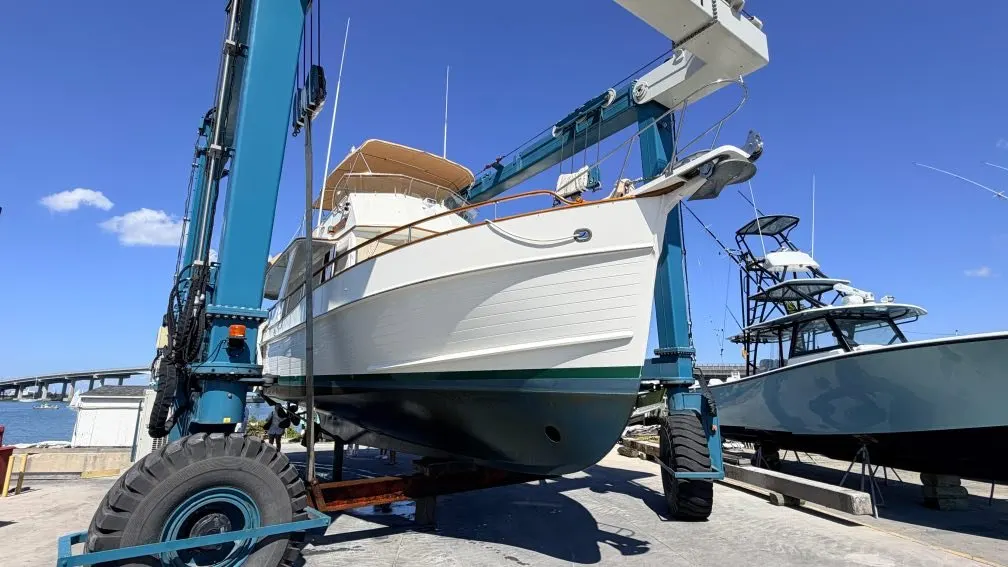
The full inspection, before the money moves. Hull, deck and structure with moisture readings and percussion testing where access allows. Engines and mechanical systems. Electrical distribution against ABYC E-11. Fuel systems against H-33 or H-24 depending on what is in the tanks. Steering, plumbing, tankage and ventilation. Safety equipment against USCG requirements and NFPA 302. Rigging on sailing vessels.
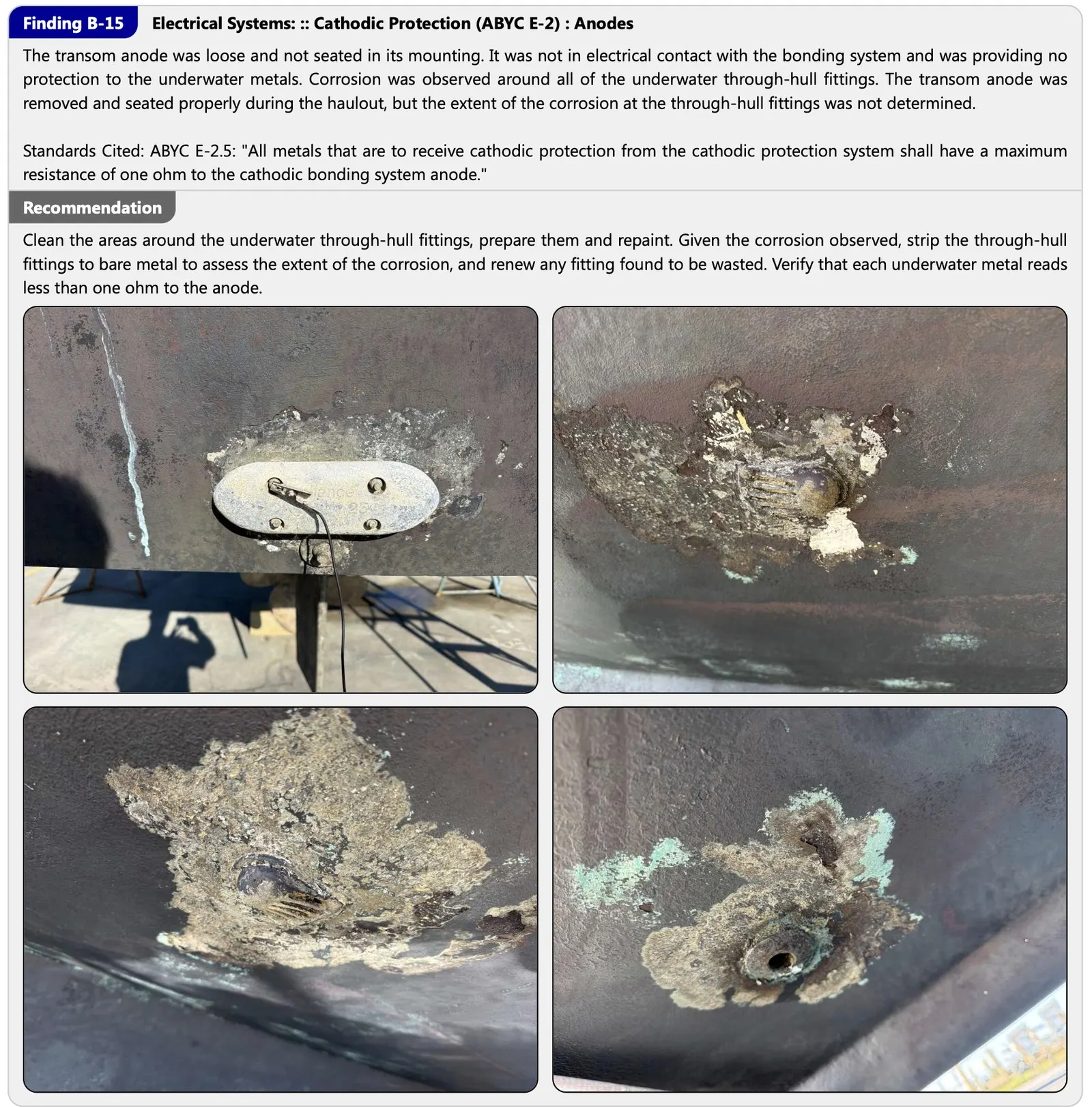
Every finding is photographed and measured against the published standard it falls under, so you can see the reasoning rather than taking my word for it. The report is in your hands the next day, which matters when a contingency period is counting down and the broker is asking whether you are still interested.
I work for you. Not the seller, not the broker, not the marina. I do buyer-side and owner-side work only, which means nobody on the other side of this transaction is paying me.
There is more on what a boat survey includes, area by area, and on the trial run and what it shows that a boat sitting in a slip cannot.
Insurance and renewal survey
A condition and valuation survey, written the way carriers ask for them. It documents condition, safety and systems, and states a current market value. Most underwriters want one before they will write a new policy, and many want a fresh one at renewal once a hull reaches a certain age.
What a carrier actually asks for varies more than people expect, so there are separate notes on boat insurance survey requirements, on insurance surveys on older boats, and on renewal surveys and the deadline they usually arrive with.
Damage survey
Cause and extent of the damage, with the cost of repair, documented and photographed for your carrier or adjuster. I record what failed, what it affected, and the condition of the systems around it, because the second question after what broke is always what else it took with it.
More on damage surveys.
Engine survey
Propulsion engines and generators on their own, in detail. Mounts and alignment, cooling, exhaust against ABYC P-1, fuel against H-33, belts, hoses, electrical connections and the service history, such as it exists. On a lot of boats the service history is a shoebox, and that is its own finding.
More on the engine survey.
Appraisal survey
An independent valuation for financing, insurance, an estate, a donation or a dispute. All of those end up in front of somebody who reads the methodology rather than the total, so the condition inspection and the comparable sales I used are both written into the report.
More on the appraisal survey.
Preliminary survey
A shorter walk-through, used by buyers who are looking at three boats and would rather not pay for three full surveys to find out which one is worth the full inspection. It is a filter, not a report an underwriter will accept.
More on the preliminary survey.
Surveys by type of boat
The inspection does not change from one hull to the next. What changes is where the findings cluster, which is why there are separate notes on a sailboat survey, a sportfish survey and a trawler survey.
If the boat is passing through rather than sitting in a local slip, there is more on surveys for boats on the Intracoastal, where the job is usually scheduling around a weather and bridge window.
What every survey has in common
I come to the boat. Dock, yard, private slip, or a trailer in a storage lot.
Every finding is graded and photographed, and measured against the published standard it falls under rather than against my own opinion. Where a finding falls under ABYC, NFPA 302 or an applicable CFR, I name it and say why it matters.
The report arrives the next day. Not next week. You can see what my reports look like before you book one, which seems a reasonable thing to want.
What it costs
My minimum is $1,050. Most pre-purchase surveys up to 55 feet land between $1,050 and $1,650. Insurance and condition surveys start at $1,050. Over 55 feet, let’s talk about the boat.
I price on the effort the vessel actually takes rather than by the foot, because a tidy thirty-eight footer and a neglected one are not the same day’s work. Length, age, survey type, haul-out, how complicated the systems are and how far I travel all move it. There is a fuller breakdown of what a boat survey costs and what drives it.
The credentials behind it
I am a SAMS® Surveyor Associate with the Society of Accredited Marine Surveyors, and an ABYC Master Advisor, certified in Marine Electrical, Marine Systems and Standards. I am a member of ABYC and of NFPA, dues current. I trained at the Chapman School of Seamanship in Small Craft and Yacht Surveying, and completed their Damage and Claims Survey courses, basic and advanced.
The electrical certifications are the ones that earn their keep most often. A startling share of what I find on a boat traces back to somebody doing their own wiring on a Sunday afternoon. There is more on how I got here.
In the last twelve months I have surveyed 6,287.5 feet of boat, covering $26,843,957 in vessel value.
What clients say
Thirteen reviews on Google, all five stars. Read them on Google, or there are more on the reviews page.
This is my 5th survey on a boat. This was by far the most comprehensive survey I've had done. Andrew is very thorough, extremely knowledgeable, and explains everything he does through the entire process. If I ever need another survey, this is the business I will call.
If you need a marine surveyor who treats your potential purchase like his own, hire Andrew. My wife and I were looking at a new left over boat that had been sitting on a dealer lot for three years and needed to know exactly what hidden issues we might face. Andrew didn't just give us a superficial write-up for insurance purposes; he handed us a meticulously detailed punch list that serves as my total restoration guide if we decide to buy the boat. Andrew has a unique gift for breaking down complex boat concerns and potential issues so they make perfect sense, no matter your experience level. He takes his time, never rushes you, and ensures you are fully educated. We highly recommend him!
Marine Surveys (Andrew) came out and did a survey for our 48 foot Albin after the marina damaged her during a haul out. The marina wanted to handle the damage at their own expense and got their own estimates that did not truly reflect the level of damage. After we provided them with this survey, they filed an insurance claim and now our boat is being properly handled for repair. Huge thank you!!!!!
Common questions
How soon can you get to the boat?
Usually within a few days. Call and tell me where the boat is and what the deadline is, and I will tell you straight away whether I can make it. I answer the phone seven days a week, 7am to 7pm.
How long does a survey take?
A pre-purchase survey on a mid-size boat is most of a day on the vessel, plus a haul-out and a trial run where the schedule allows. Bigger or more complicated boats take longer. The report is written up afterwards and reaches you the next day.
Do I need to be there?
No, but come if you can. Walking the boat with the person who is about to own it is worth more than any amount of writing afterwards, and the questions people ask standing in an engine room are better than the ones they ask over email.
Does the boat have to come out of the water?
For a pre-purchase survey, yes. Everything below the waterline is invisible otherwise, and that includes the parts that are most expensive to get wrong. For some insurance work an in-water survey is acceptable, which is a question for your carrier rather than for me.
Do you work for the buyer or the seller?
Buyers and owners only. I do not take pre-listing or seller work, so there is never a question about who is paying me on the day I write your report.
Will you tell me whether to buy it?
No, and you should be wary of a surveyor who will. My job is to describe the condition of the vessel and grade every finding against the standard it falls under. What that is worth to you depends on your budget, your plans and your appetite for a project, and none of those are mine to judge. You will have what you need to decide.
Where I work
Coastal North Carolina out of New Bern, running from Hampton Roads in Virginia down to Myrtle Beach in South Carolina. That covers Oriental, Washington, Beaufort, Morehead City, Wilmington, Wrightsville Beach and Southport, plus Hampton in Virginia and Myrtle Beach in South Carolina. The Outer Banks too.
Where you are does not matter. Plenty of my clients are buying a boat from several states away and have never seen it in person. Where the boat is, is the question. If it is sitting anywhere on that stretch of coast, call or text and tell me about it.