
What My Survey Reports Look Like
A survey is only worth what the report communicates. You should know what you are getting before you book, so here is how mine are built.
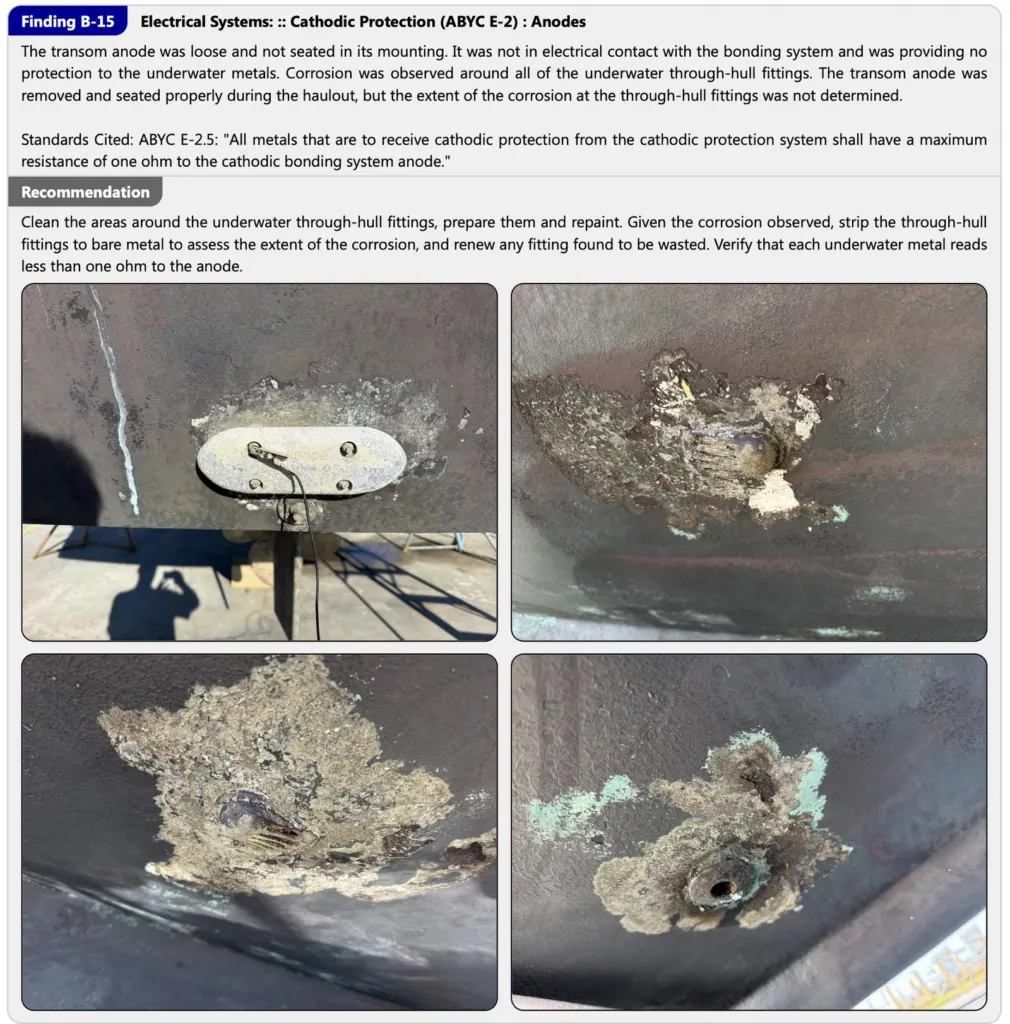
How Findings Are Written
Plainly, in language you can use with a broker, a yard or an underwriter. Each finding says what I observed, where, and what standard it is measured against. No hedging, and no jargon you have to decode before you can act on it.
Where a finding is serious, it says so. Where it is a maintenance note, it says that too. Flattening everything into one worried tone helps nobody.
How Findings Are Categorized
Findings are separated by urgency, so a safety item that needs addressing before the boat moves is never buried among cosmetic notes. That separation is what makes the report usable as a negotiating document and as a work list afterwards.
Photographs and Evidence
Findings are photographed. A written description of corrosion at a battery terminal is an assertion. A photograph of it is evidence, and evidence is what a seller, a yard or an insurer responds to.
Moisture readings and test results are recorded with their locations, so the next surveyor to look at that boat can compare against what I found rather than starting over.
Read a Full Sample Report
A complete pre-purchase survey on a 2002 Mainship Trawler 390, 62 pages, as I wrote it. Names, the hull number and any photograph showing the vessel name are taken out. Nothing else is changed.