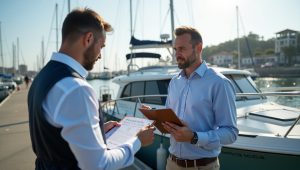
You are about to spend forty, sixty, or a hundred thousand dollars on a boat. You have found one you like. The seller says it is in good shape. The broker says it surveys well. The pictures look clean. And somewhere underneath all of that, there is a version of events where the stringer is soft with moisture intrusion, the raw water impeller has not been touched in four years, and the bilge wiring looks like it was done by someone who has never heard of ABYC standards. The survey is the only thing that stands between you and that version of events. What the survey finds depends almost entirely on who performs it.
Marine Survey NC is a SAMS Surveyor Associate marine surveying firm serving boat buyers, owners, and insurers across coastal North Carolina — Wilmington, Morehead City, Beaufort, and New Bern — and inland across the Charlotte and Lake Norman market. Every survey is completed by an certified professional whose credentials are publicly verifiable, whose report satisfies lender and insurer requirements, and whose methodology goes beyond what is visible from the dock.
Who We Are
Marine Survey NC is a professional marine surveying firm built on one standard: every vessel inspection should be thorough enough that the client can make a fully informed decision. In practice, that requires more than walking a boat and writing a summary. It requires knowing what you are looking for, having the instruments to find it when it is hidden, and operating under a professional framework that holds the surveyor accountable for what the report says.
We are SAMS Surveyor Associate — Society of Professional Marine Surveyors. The designation is not a membership. It requires a written examination, documented vessel experience, a code of ethics, and continuing education to maintain. It is verifiable on the SAMS public directory before you book anything. We will come back to why that matters for your specific transaction.
We cover two distinct NC markets: the coastal waterways from Wilmington and the Cape Fear River north through Morehead City, Beaufort, and New Bern, and the freshwater market at Charlotte and Lake Norman. Both have their own inspection priorities, their own common failure patterns, and their own vessel histories. Most NC surveyors work in one environment. We work in both.
What We Survey and What We Look For
The pre-purchase survey is the most common engagement. A buyer has found a vessel they are serious about. The survey is the professional evaluation that tells them whether the vessel matches the seller’s representation — and what it will cost if it does not.
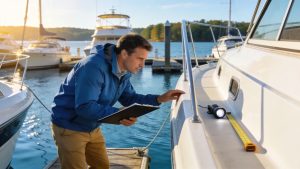
A Marine Survey NC pre-purchase inspection covers:
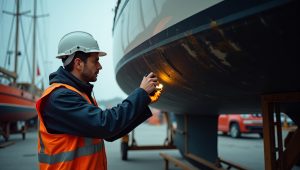
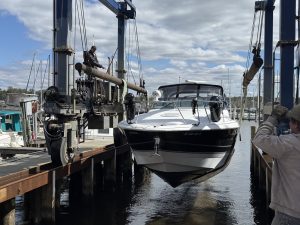
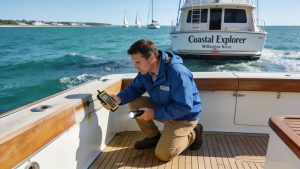
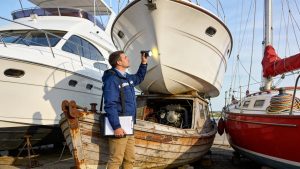
- Hull and deck, above and below the waterline. Below-waterline inspection requires a haul-out — lifting the vessel so the running gear, keel attachment, through-hull fittings, and hull bottom can be visually examined and probed. We use a moisture meter to identify moisture intrusion in fiberglass core material that is invisible to the eye. A soft reading on the transom or along the waterline can indicate delamination or osmotic blistering that will cost thousands to repair. This is not optional.
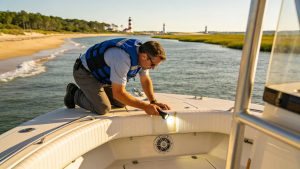
- Structural components. Stringers, bulkheads, transoms, and structural modifications. This is where the most expensive hidden damage lives — moisture-saturated balsa or plywood core in a cored hull, inadequately repaired collision damage, a transom that has been rebuilt but not correctly. Boats from the 1980s and early 1990s are particularly susceptible to core moisture issues that decades of antifouling paint can obscure.
- Mechanical systems. Engine hours and condition, cooling systems, fuel systems, steering, through-hulls. Not a mechanic’s bench evaluation, but a surveyor’s documented assessment of observable condition and deferred maintenance risk. High-hour engines with no service records are flagged. Impeller condition and raw water system integrity — a common failure point on coastal NC vessels — gets specific attention.
- Electrical systems. Boats of any age can present fire and safety risks in the electrical system. Shore power connections, battery systems, bilge pump operation, navigation lights, and wiring condition. On boats that have been owned by multiple parties over the years, the electrical system is often where modifications have been made by people who were not electricians.
- Safety equipment compliance. USCG-required safety equipment, flare expiration, fire extinguisher condition, life ring accessibility. An insurance survey in particular focuses heavily on compliance — the insurer needs to know the vessel is safe to operate.
- Market valuation. The survey report includes a professional market valuation — the number your lender uses for loan-to-value calculation and your insurer uses to set coverage value. The valuation reflects current NC market conditions, not the asking price.
The Sea Trial
On a pre-purchase survey, the sea trial is where the mechanical systems are evaluated under operating load. We accompany the buyer on the trial, observing engine temperature, oil pressure, steering response, transmission engagement, and any handling anomalies that only appear underway. For vessels with inboard engines, the sea trial is where oil cooler problems, overheating patterns, and exhaust smoke that indicates internal wear become visible.
The buyer typically arranges the sea trial and covers fuel cost. We advise the buyer on what to watch for during the run and document what we observe. A survey without a sea trial on a powerboat is an incomplete evaluation of the vessel’s mechanical condition.
Buying a boat in coastal NC or Charlotte/Lake Norman? Schedule your pre-purchase survey at marinesurveync.com/services
Insurance and Damage Surveys
Insurance surveys are performed at the insurer’s request — typically when a policy is placed with a new carrier, when an older vessel changes hands, or when an insurer reviews its book and requires updated condition documentation. The insurance survey answers one specific question: is this vessel in insurable condition at the stated value? Marine Survey NC reports are accepted by the major marine insurers operating in North Carolina.
Damage surveys document the extent and cause of damage after an incident — grounding on the Beaufort Inlet shoals, a collision on the ICW, storm damage during hurricane season, flooding at the slip. The damage survey is what your insurer uses to evaluate the claim and authorize repair. It needs to be thorough, it needs to be specific, and it needs to hold up to scrutiny from the insurer’s adjuster. We have been through that process many times.
Our Service Area: Coastal NC and Charlotte/Lake Norman
Most NC surveyors cover one environment. We cover two — and they require genuinely different knowledge.
Coastal NC: The Cape Fear River corridor from Wilmington to Carolina Beach, Wrightsville Beach, Masonboro Inlet, Beaufort and the Back Sound, Morehead City and the Newport River, New Bern and the Neuse/Trent confluence, and the ICW throughout the coastal region. Coastal NC boats age differently. The combination of salt air, warm water, and ICW traffic — with its constant wakes and debris — produces specific wear patterns. Osmotic blistering is common on fiberglass hulls from the 1980s and 1990s. Galvanic corrosion on aluminum outdrives and lower units is routine on vessels that have lived in brackish ICW water. Running gear on sportfishers working out of Morehead City or Wrightsville Beach shows the kind of hour accumulation that a Lake Norman boat rarely sees.
Charlotte and Lake Norman: The freshwater environment changes the inspection entirely. Corrosion is far less prevalent. Bottom paint and antifouling history are different. Winterization and storage practices — boats in NC’s freshwater market often dry-store over winter, unlike coastal vessels in slips — affect what condition issues develop over time. Pontoon and deck boat construction has specific inspection priorities that differ from saltwater center consoles and sportfishers. Lake Norman is one of the largest reservoirs in the Southeast, with an active market in powerboats, sailboats, pontoons, and ski boats. We know what to look for on them.
Coastal NC or Lake Norman — we cover both. Check service area details and request a quote at marinesurveync.com/service-area
How to Get Started
Contact us through the website. The request form asks for the vessel’s basic details — type, approximate length, location, and your preferred timing. We confirm availability and quote a fee before anything is scheduled. No surprises on the invoice after the survey is complete.
Survey fees on pre-purchase inspections run $20–$25 per foot of overall length. Haul-out fees are separate and vary by boatyard. A 35-foot coastal NC center console, fully inspected including haul-out, typically runs $700–$875 for the survey plus $200–$400 for the short haul. That is the cost of knowing what you are buying before you own it.
First-time boat buyers are welcome to call before booking. We answer questions about the survey process, what the report will include, and how to use the findings in a purchase negotiation. The survey should make your buying decision clearer, not more confusing.
Frequently Asked Questions
Do I really need a survey if I’m paying cash and skipping the lender?
The lender’s requirement is the floor, not the ceiling. The survey protects you — not the bank. A $500 survey on a $60,000 boat is the cheapest due diligence available on a six-figure-adjacent purchase. The boats that skip surveys are the ones where buyers call us six months later asking if we can look at a problem they just discovered.
Does the pre-purchase survey include a sea trial?
Yes. We accompany the buyer on the sea trial and document mechanical system performance under operating load — engine temperature, oil pressure, transmission engagement, steering response, and any handling anomalies that only appear underway. The buyer arranges the trial and covers fuel cost. We cover the evaluation.
How much does a marine survey cost in NC?
Pre-purchase surveys run $20–$25 per foot of overall length. A 30-foot vessel runs $600–$750 for the survey; a 40-footer runs $800–$1,000. Haul-out for below-waterline inspection is billed separately at boatyard rates — typically $200–$400 for a short haul. Travel fees apply for vessels outside the primary service areas. We quote before we schedule.
Can I be present during the survey?
Yes, and we recommend it. Buyers who attend their surveys understand the vessel’s condition in a way that a written report alone cannot convey. You see the moisture meter readings on the transom, the impeller housing corrosion pattern, the electrical issue behind the nav station. That real-time understanding makes the post-survey negotiation much more straightforward.
Will Marine Survey NC reports be accepted by my lender and insurer?
SAMS Surveyor Associate reports are accepted by major marine lenders and insurers in NC. If your specific lender or insurer asks about the credential, we can provide SAMS documentation directly. This is rare — the certification is recognized across the industry.
Don’t close without knowing what you’re buying. marinesurveync.com/services | Coastal NC and Charlotte/Lake Norman