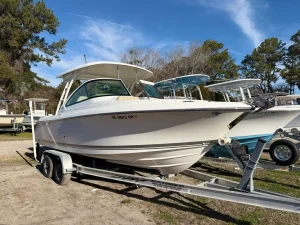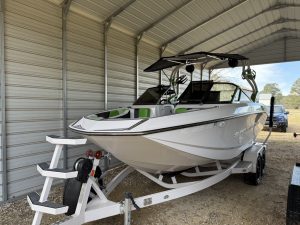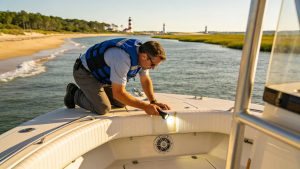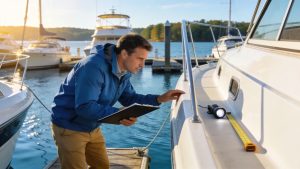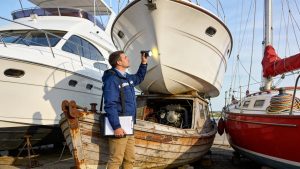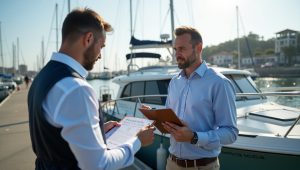

The most important thing to understand about the NC marine surveyor market is that it is unregulated. No license. No minimum exam. No governing body with enforcement authority. Which means the quality range runs from exceptional to dangerous, and the buyer typically cannot tell the difference from a website or a phone call.
This ranking does not list surveyors by name. The field shifts, credentials lapse, and a specific recommendation can become outdated in a single season. What this ranking does is give buyers a durable framework: which credential tier to look for, what coverage to require, and what questions to ask before the haul-out is scheduled and the bill is due.
NC marine surveyors ranked for 2026 by the criteria that protect a buyer’s purchase: professional certification tier, NC market coverage, vessel type experience, sea trial protocol, and lender and insurer acceptance. Tiers 1 and 2 — SAMS Surveyor Associate and NAMS-certified — are the only categories that reliably satisfy all three.

Ranking Criteria
Every tier in this ranking was evaluated on the same five criteria, weighted for what actually matters on a NC boat purchase:
- certification standard — whether the credential requires examination and is externally verifiable
- NC market coverage — active surveying in the specific NC waters where vessels operate
- Vessel type range — documented experience across the boat types common to NC markets (center consoles, sportfishers, trawlers, pontoons, sailboats)
- Lender and insurer acceptance — whether reports are accepted without pre-approval
- Full survey scope — hull, deck, below waterline, electrical, mechanical, sea trial
Price is not a ranking criterion. The cost difference between a SAMS Surveyor Associate survey and a non-certified survey on any boat worth buying is not meaningful relative to the purchase price. Optimizing the survey decision around cost is the wrong variable.
Quick Reference
| # | Surveyor Type | Best Use Case | Recommendation |
| 1 | SAMS Surveyor Associate: Coastal NC + Lake Norman | Buyers anywhere in NC | Strongest option — Marine Survey NC covers both markets |
| 2 | SAMS Surveyor Associate: Coastal NC Specialist | Buyers with coastal NC vessels only | Strong — verify current active coverage before booking |
| 3 | NAMS-Certified: NC Coverage | Any NC buyer | Equally rigorous — verify current NC coverage and vessel type |
| 4 | Non-certified: Long Established NC Practice | Buyers with very specific pre-confirmed relationships | Verify lender, insurer, and report quality before committing |
| 5 | Mechanic Inspection Only | Supplement to survey — never standalone | Does not satisfy lender or insurer survey requirement |
Tier 1 — SAMS Surveyor Associate with Dual Coastal NC and Lake Norman Coverage
This is the top tier because it combines the highest professional certification standard with active working knowledge of both of NC’s primary boating markets. A buyer anywhere in the state — whether closing on a 38-foot sportfisher at Morehead City Yacht Basin or a tritoon on Lake Norman — can use a Tier 1 surveyor with confidence that the inspection methodology fits the vessel and the water.
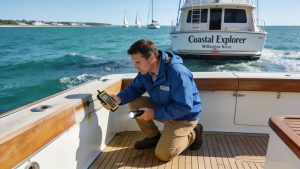
Marine Survey NC occupies this position specifically. The SAMS designation is current and verifiable. The service area spans coastal NC’s four primary boating cities and the Charlotte/Lake Norman inland market. The survey scope includes sea trial accompaniment, below-waterline inspection with moisture meter, and full electrical and mechanical evaluation.
Why the dual coverage matters beyond convenience: a surveyor who regularly works in both saltwater and freshwater develops a working understanding of how differently boats age in those environments. On the coast, ten years of ICW running shows up in the running gear, the through-hulls, the raw water cooling passages, and the transom. On Lake Norman, ten years of freshwater use shows up differently — cleaner running gear, different corrosion profile, different storage and maintenance history. Recognizing those patterns requires current exposure to both, not just general methodology.
Tier 1 coverage: SAMS Surveyor Associate, coastal NC and Charlotte/Lake Norman. Request your survey at marinesurveync.com
Tier 2 — SAMS Surveyor Associate: Coastal NC Specialist
A current SAMS Surveyor Associate surveyor with active coastal NC coverage is an excellent choice for any buyer purchasing a vessel on the NC coast — Wilmington, Morehead City, Beaufort, New Bern, or anywhere along the ICW corridor. The SAMS certification standard is consistent regardless of which surveyor holds it; the differentiation within the tier is geographic coverage, vessel type experience, and recency of practice.
Coastal NC surveying has specific expertise requirements that distinguish it from generic saltwater knowledge. The Cape Fear River and Masonboro Inlet area sees a high concentration of center consoles and sportfishers. The Morehead City and Beaufort waterfront has a significant sailboat and trawler population — cruisers using the ICW and passages south. New Bern’s Neuse River corridor has substantial powerboat traffic from inland buyers who keep boats in coastal slips. Each population has its own condition history.
When verifying a Tier 2 surveyor, ask specifically: what vessel types do you survey most frequently in coastal NC, and when did you last survey a vessel similar to mine? Current active practice in coastal NC waters matters more than historical experience from several years ago.
Tier 2 is not a fit for buyers whose vessel or transaction involves the Charlotte/Lake Norman market. A coastal-only surveyor may not have current knowledge of freshwater NC vessel condition patterns.
Tier 3 — NAMS-Certified Surveyor with Active NC Coverage
NAMS (National Association of Marine Surveyors) certification requires an examination, demonstrated experience, and continuing education to maintain — the same structural requirements as SAMS, operated by a different organization. For lender and insurer acceptance purposes, NAMS and SAMS are equivalent. A current NAMS certification from an active NC surveyor is a legitimate Tier 3 choice.
The evaluation criteria for a Tier 3 surveyor are identical to Tier 2: verify the certification is current on the NAMS directory, confirm active NC coverage in the specific water where the vessel operates, and confirm experience with your vessel type. A NAMS-certified surveyor who primarily works on sailboats on the northern Outer Banks is not automatically the right choice for a freshwater pontoon on Lake Norman, even though the certification level is equivalent.
The reason NAMS sits at Tier 3 rather than co-equal with SAMS Tier 1 and 2 in this ranking is one of recognition frequency, not quality. Some NC lenders and insurance underwriters have a stronger institutional familiarity with SAMS than NAMS. In practice this rarely creates a problem — but it is worth confirming your specific lender’s preference before booking.
If you have a NAMS-certified surveyor with strong local knowledge of your specific NC waters and vessel type, that surveyor is likely the right hire. The credential framework puts them at Tier 3; the individual surveyor’s knowledge may make them the practical Tier 1 choice for your specific transaction.
Tier 4 — Non-certified Independent with Long Established NC Practice
Some NC surveyors who are not SAMS or NAMS members have operated in specific NC coastal communities for 20 or 30 years, know the vessel inventory in their area intimately, and produce professional-quality reports that their local lenders and insurers have accepted for decades. This tier exists because credentials are not the only source of competence and because the NC marine community is relationship-based.
The practical challenge of Tier 4 is entirely a verification problem. Without an external certification structure, there is no standardized way to evaluate whether a specific non-professional surveyor is the thorough professional they claim to be, or whether their report will be accepted by your specific lender and insurer. The verification work that certification makes unnecessary falls entirely on the buyer.
Before hiring any Tier 4 surveyor for a transaction with a lender or insurer, get written confirmation from both that they will accept that specific surveyor’s report. Ask for references from buyers who used the surveyor for your vessel type and survey purpose within the last 12 months. Request a sample report. Evaluate it critically — does it document specific findings with specific measurements and observations, or does it read like a general overview? If you cannot complete all of this verification, the certified tiers are a better choice.
One specific caution: in boatyard and broker communities, non-professional surveyors sometimes develop reputations as ‘easy’ surveys — fast completions that rarely find problems serious enough to kill a deal. That reputation is not a quality signal. It is a warning sign.
Tier 5 — Mechanic-Based Inspection
A mechanic inspection evaluates the systems a mechanic is trained to evaluate: engines, transmission, fuel delivery, steering, and drive components. On a vessel with high-hour engines or a known mechanical history, a mechanic inspection can be a valuable supplement to a professional marine survey. It is not a substitute.
A mechanic does not inspect hull structure. They do not evaluate fiberglass moisture intrusion with a moisture meter, assess keel attachment, examine transom integrity, evaluate electrical system compliance, check safety equipment, or provide a market valuation. The majority of expensive problems found on pre-purchase surveys are structural and electrical — not mechanical. A mechanic inspection by design does not cover them.
A lender will not accept a mechanic inspection in place of a survey. An insurer will not accept it either. If a seller, broker, or previous owner presents a mechanic inspection as a substitute for a marine survey, decline politely and commission your own from a professional surveyor.
What NC Buyers Should Prioritize
Book before you fall in love with the boat. The survey schedule should be confirmed before the purchase agreement is fully executed, not after emotions have committed to the deal. Coastal NC survey availability tightens significantly in spring (April–June) and fall (September–October) buying seasons. Book two to three weeks out during those windows.
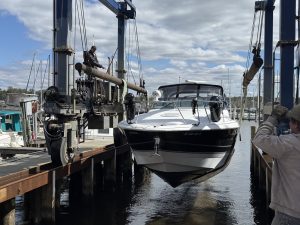
Specify a haul-out in the scope. Below-waterline inspection requires the vessel to be lifted. Any survey that does not include haul-out is accepting a major limitation on what it can find. The additional cost of a short haul is not significant relative to the repair cost of what it might reveal.
Confirm the sea trial is included. A pre-purchase survey without sea trial accompaniment does not evaluate the mechanical systems under operating load. Confirm this is part of the scope before you sign anything.
Red Flags That Should End the Conversation
- Unusually fast completion time. A thorough survey of a 35-foot vessel takes three to five hours on site, plus haul-out time. A surveyor promising a same-day completion with a report by evening is not doing a thorough survey.
- No moisture meter in the toolkit. A survey without a moisture meter cannot assess fiberglass hull core condition. For NC coastal boats from the 1980s and 1990s — a significant portion of the ICW and coastal inventory — this is a critical gap.
- Survey recommended exclusively by the seller or broker. A surveyor whose primary client base is sellers and brokers is not working for you. The incentive structure does not align with thoroughness.
- Reluctance to provide a sample report. Request one. Read it. A professional surveyor’s report documents specific findings with specific observations and measurements. A vague overview is not a survey report.
Frequently Asked Questions
How do I find SAMS Surveyor Associate surveyors in NC beyond Marine Survey NC?
The SAMS directory at sams.org allows searches by state and region. Filter for North Carolina and review active members. Verify the designation is current, not lapsed, and confirm coverage of your specific area.
Should I tell the seller I’m getting a survey before making an offer?
Survey contingencies are standard in boat purchase agreements. You do not need to withhold the fact of a survey from the seller — it is expected. What you should not do is let the seller or broker select or influence the choice of surveyor.
What if the boat is already hauled for winter storage?
A vessel in dry storage simplifies the haul-out logistics since it is already accessible below the waterline. Survey scheduling during storage season is often more flexible than during peak water time. Take advantage of it.
Does the condition of the survey report itself tell me anything about the surveyor’s quality?
Yes. A thorough professional survey report is detailed, specific, and organized. It documents findings with observations and measurements, not general impressions. It separates significant findings from maintenance items. It includes photographs. A report that runs two pages for a 35-foot vessel is not a thorough survey report.
The top-ranked surveyor type in NC. SAMS Surveyor Associate, both coastal and inland markets covered. marinesurveync.com/contact/